



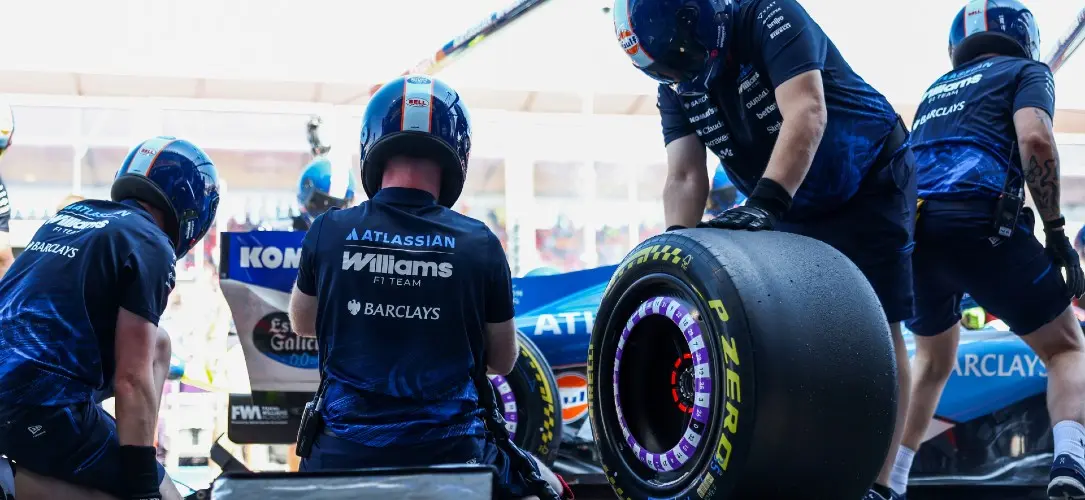
In our exclusive interview, Atlassian Williams F1 Team's Gorka Narbarte reveals what it takes to deliver a perfect pit stop, from completing more than 1,000 tyre changes a year to handling the pressure of race day.
In a season, how many times do Pit Crew members change tyres, and how do you practise?
We’ve got many different ways to practise. For example, when it’s a race weekend, we will practise before our free practice session. We will have the car rolling through the pit lane, we’re pushing the car and then stopping on the marks before doing the stops.
Then we’ve got live stops, which we can do during our free practice, for example. We will try to stop the car on the marks and change the tyres as often as we can, because that’s the most representative practise against the race itself, as everyone is in the right position, the car is rolling because it’s driven by the driver, and then the speed and the motion is more representative.
We also have a similar scenario in the factory where we will push the car in a tent where we will do full crew stops. But we will also have a rig here in the factory where we will try the stops by corner.
We will go over 1,000 stops in the year. It could vary between a guy that has done it very often, an experienced corner, or a very changeable corner where we have different mechanics rotating in. Those guys might do it more often to try get into a rhythm and get a good motion for the stop itself.
But we do over 1,000. I wouldn’t be able to say an exact number, but in between all those practice ones, we will do over 1000 of them.
In general, F1 fans probably only see the tyre changes, but how many different tasks are there for Pit Crew members to take care of?
Each Pit Crew member has a job assigned. There are different roles in the factory and different roles in the racing. We’ve got garage technicians, for example – they look after the garage itself, the tyres and the fuel. Then we’ve got hydraulic technicians, sub-assembly technicians, car mechanics, and then we’ve got No. 1 mechanics – I’m one of those for Alex [Albon].
Each one of those will have a designated job list. We’ve got many different jobs to do through the week. For sure, they take up most of our day and then pit stop practices, which are still very important to us. But they’re probably less invasive or less time-consuming on a normal day-to-day basis than what people think.
So we build the cars, we sign off all the processes and ensure that the car is always built to the right spec. It’s always building the right timing. Then we service components, go through mileages and so on. We organise crews and people, we do logistics as well. We will unload containers and build the garages and everything too. So there are many different jobs that a Pit Crew member will do.
What’s the best or most common pathway to becoming an F1 Pit Crew member?
Obviously, you need to make it to an F1 team. But before you make it there, you will have to work in different series to increase your knowledge, increase your capabilities and show to an F1 team that you’re doing worthwhile work and trying.
Once you make it to a team, then it will be a number of factors. Certain teams will take you to the race team sooner than others because they have less personnel. Certain other teams, they have a very clear structure of how they do things. For example, a brand-new mechanic will come to the factory, will work with us for a number of months or years, and then eventually will go to a test team.
After test teams, we might rotate for another test event with a race crew and then eventually they will make it to the race team itself. Once you are with the race team, then you need to prove your physical level, as well as your skills, to make it to the pit crew.
We try it with most of the people we have with us, to ensure that we can have people coming in to do different roles. Most of the people that are still factory based who don’t ever come to a race will have done certain stops in the rig, because that’s something that is very good for us.
The rig allows us to throw people in and do stops without the limitation of having to be at an event or have the car built. This gives us the opportunity to try different people and ensure that they get to a certain level before they get thrown into a proper practise stop with a full crew.
Are Pit Crew members also engineers?
No, not necessarily. It’s not a requirement. There are certain people with a degree or who have had different studies. It could be that you’ve got engineers doing pit stops, but you don’t necessarily need to be. You clearly need to have a skill set and certain knowledge to be around the car, because people are not fully aware of is how dangerous a pit stop could be.
The pit stops are always very calm and collected because every single team does a very good job at training their personnel. But if you imagine a scenario where you’re in Malaysia or Singapore, or any place where it could properly rain, when the pit lane is busy and you have 22 cars coming at 60 or 80 miles an hour, then you need to be trained and experienced enough to understand that there are certain things outside of your areas that could be dangerous – whether it’s a car locking up or coming backwards to the pit box, or even another competitor getting too close to the gun lines when he’s driving out.
So for the gunmen, we have our air lines, which are linked to us for when we’re grabbing the gun itself. If something grabs that line, it’s very dangerous for us as well as the people around us. It’s the same with the wheels, if you place the wheel in the wrong place and one of the other cars goes through it, that could be spat out at somebody, or in the way of another car. So, you’ve got to be experienced enough to understand these sorts of things. There is danger to do the stop itself, but there is also danger to have other cars around you.
The 2026 cars have different dimensions and new active components. Has the physical execution of a pit stop had to change, and where are the new margins for error?
Year after year, maybe not all of them, but some of the times the look of the car itself can change. So, the auto components and aero components are slightly different. That of course will affect us. For example, from last year to this year, we introduced patch boards, which is a big carbon element behind the front wheel. That has made the front wheel longer as it stands in a different position because their feet would be right where it was in last year’s car.
Due to those changes, it does change how we operate. Then the wheels are slightly different. We used to have the aero leads where they had a funnel shape, so it was easier for the gunmen because we would just throw the gun and the funnel will help you to guide into the nut, but that’s not the case anymore because the regulation has changed and you need to make certain amends to your aero components.
But year after year we do change things. The biggest change there’s ever been is probably when we moved from small tyres to big tyres in 2017. That was a big, big change because the wheels were much smaller and lighter, and now they are much bigger and heavier.
That has an impact on the wheel-on guys, not only for the physics of it, but also the fatigue and repetition of doing so many.
If a car comes in with damage to an active aero component, what does that change for the crew during the stop?
We have many different scenarios. For example, a front wing could be swapped in a pit stop, so if you have an incident where you were too close to the front driver or he locks up and then you clip your front wing and lose an end blade or one of the elements of the front wing, that is something we can swap. So, you will call for a front wing change, which will be done by the team manager.
We clearly have lots of data as well as cameras in the car, and we can constantly see what’s happening, not just from the TV feed. If we do have a damage like this, that call will be made before our stop, so everyone will be ready for that before the stop happens. You then jack the car up in a different manner, because you don’t use the front jack as your front main plane could be damaged and you’re willing to remove that. So you will use a side jack to lift the front of the car up.
Then the wheel-off guys and the wheel-on guys will focus on doing the clamps, which is how we lock the front wing to the car. The front gunman will then take the wheel off, pass it on to somebody and we will put the wheel on ourselves. The stop should be completed in around 12 seconds, so we’ve got enough time to do that ourselves.
That allows us to have the wheel-off and wheel-on guys doing the nuts up into the nose box. Then the car will be dropped manually, because the side jack is not the same switch that you have for the front jack. You have to close the scissor down and then pull it out, and then the car will go.
Changing a rear wing or a floor component would take too long during a pit stop. You could do that in a red flag scenario, where some bits can be removed or you may be asked to have a look whether something is stuck on a front brake.
There may also be a racing incident, or another car loses some material, and the debris could go into your duct. That may mean the stop is a bit longer because you need to look into the front left corner, for example. But we’ve got processes in place where the wheel-off guy will remove the wheel, the wheel-on guy will stay still and the gunman will look into that area to ensure it’s all clear.
But because the pit stops are so quick there is a very limited number of items you could swap in that time.
The Canadian GP saw Alex Albon retire after a racing incident. How does the pit crew mentally reset when a race ends that way?
It’s clearly hard for us because you’re always focused on getting your car ready and getting everything done properly, and then doing the pit stops afterwards, so when something happens to the cars and you realise that you’ve worked for a full week non-stop to try to get some performance out of it and get some points out of it, and you don’t, it obviously hits you.
Every single individual that does pit stops tends to have a routine or process before they go to the next stop to ensure that their head is in the game and they’re focused on what they’re about to do. Every time you do a stop, you need to focus on what you’re doing. You don’t need to overthink it because most of it is muscle memory.
If you overthink it, you might make a mistake because you’re focusing on an individual action instead of the whole motion. But I think the process of the routine that each one of us takes will probably take most of that heat away and it shouldn’t affect you going into the next stop.
But we have had it on a number of occasions, so we need to try to keep cool and keep focused because it’s a team game, and having the two cars accomplishing the most successful race is what you’re waiting for.
Pit stop times have got faster every year. Is there a physical limit, or is it purely a process and equipment problem now?
I think there is a bit of both, but we could get quicker than what we have achieved this year so far. We have 23 pit crew members, so if the car stops bang on, and the 23 people do everything bang on, you could be sub-two seconds, which is something that some of the teams haven’t even accomplished this year.
We could get it quicker, but sometimes you’re not necessarily looking at having the quickest of the quickest time possible. You also want to make it consistent so you can picture that number and put it into your strategy, which allows you to calculate how you’re going to stop and how long you’re going to be in that box.
Absolutely, if we all aimed for the fastest possible stops and we were all good enough and lucky enough to get it bang on, it will be sub-two seconds and you could go quicker than what any team has accomplished. Any other teams could do better than what they have done so far as well.
But there are so many different factors that can impact us. If the car stops slightly skewed, you have 23 pit members switching along or moving along. If it’s raining and he’s not gripping as much, you will have 23 guys struggling.
If for whatever reason one of the corners has an issue when the wheel is not ready on time, it might have an effect on how that stop is completed. So there are so many different factors that could affect that.
Gear-wise, and equipment wise we actually get better year after year. We improve our jacks, our guns and we improve our processes. But for sure, if you were also better on that side of things, it would be better to stop overall.
Aside from the total stop time displayed on screen, what is the single most important metric you monitor that tells you whether a stop was truly perfect, or merely lucky?
We’ve got a number of sensors and cameras, and we’ve also got cameras on our chins and heads. Then there’s engineers that will go through the data, do an analysis and then they will do a report.
So after a pit stop practise session, for example, you will get a report within a couple of hours. This will show you what you’ve done in each of the stops as all of them are recorded. You will also have access to the video data so you can see if you were doing something right or wrong.
As simple as it sounds, the sound of a pit stop is quite a good metric. If you just hear one gun from the wheel-off and wheel-on, it is quite a good stop because that means that all four guns and all four stops have pretty much happened at the same time.
After the stop itself, everyone will have a feeling of how that stop went. If you messed up, you will definitely know because people have been waiting for you and then they will probably tell you about it in a good way, because we have a really good team spirit. If someone makes a mistake, we will try to ensure that he is comfortable enough not to make that mistake again during the next stop, and then ensure their mind is away from that issue and looking forward to the next one.
Visit Betway’s F1 betting page for all the latest odds, markets and specials.