



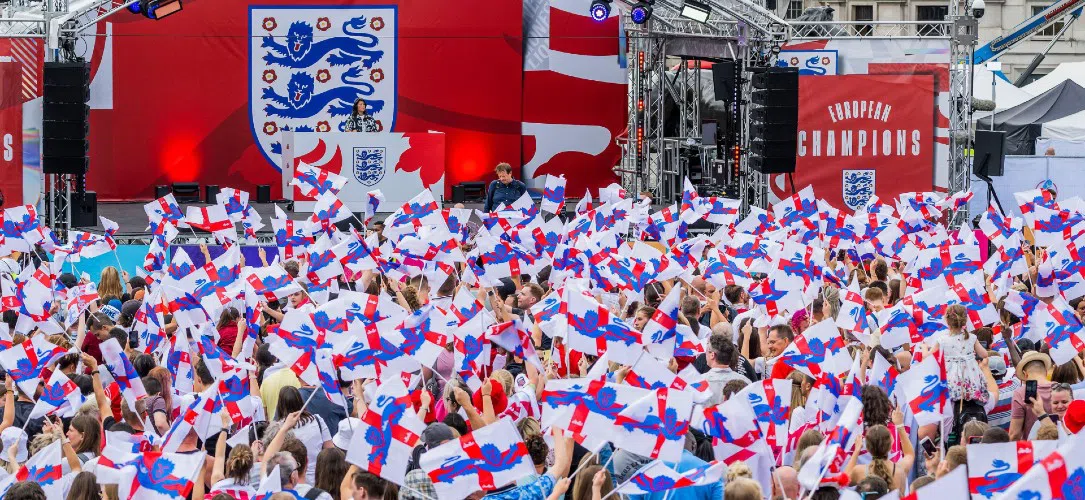
With England one game away from a second consecutive European Championship triumph, we examine the Lionesses' history in the competition.
England are in the UEFA Women’s Championship final once again, and will look to earn a historic back-to-back triumph in Basel on Sunday 27 July.
The Lionesses came into the tournament as the second favourites in the Women’s Euros odds, with manager Sarina Wiegman bidding for a hat-trick of titles after leading the Netherlands squad to glory in 2017, when her side overcame England in the semi-finals.
With stunning comeback victories over Sweden and Italy in the knock-out rounds, it has been a wild ride for England in Switzerland and the Lionesses may feel their name is destined to be etched onto the trophy again.
The story of England at the UEFA Women’s Championship, commonly known as the Euros, is one of perseverance, growth and ultimately triumph.
From humble beginnings and early heartbreak to a historic victory on home soil, their history mirrors the rise of women’s football in England and Europe.
Early years and the first final (1984)
England’s participation in the Women’s Euros began with the very first tournament in 1984, when it was known as the European Competition for Women’s Football.
The format was markedly different from the one in operation today – there was no central finals tournament, but rather a series of home-and-away matches between group winners.
England fell at the final hurdle after topping their group and defeating Denmark over two legs in the semi-finals.
After losing 1-0 away to Sweden in the first leg of the final, Martin Reagan’s side won the return clash 1-0 in front of a crowd of 2,567 at Luton’s Kenilworth Road, before they suffered heartbreak in a dramatic penalty shootout.
However, that run had established England as a force in the women’s game.
Struggles and missed qualifications (late 1980s-1990s)
The late 1980s and 1990s proved challenging for England, who failed to qualify for the semi-final stages in 1989, 1991 and 1993 following a fourth-placed finish in 1987.
They did not reach the finals at all in 1997 as the competition evolved into something that resembles the current format, with eight teams convening for a tournament in Sweden and Norway.
Germany clinched their fourth title that summer, but England were about to receive a major boost with the appointment of former captain Hope Powell as the first full-time coach of the women’s national team.
A new millennium and renewed ambition (2000s)
The turn of the millennium saw England striving to reclaim their place among Europe’s elite. In 2001 and 2005 they qualified for the finals but exited at the group stage, however, hosting the 2005 tournament was an important milestone.
Matches drew record crowds and the Lionesses’ 2-1 win over Finland at the City of Manchester Stadium was watched by more than 29,000 fans, a European record at the time.
This period also saw the establishment of youth teams and a deepening talent pool, laying the groundwork for future glory.
Return to the final (2009)
England’s resurgence culminated in reaching the 2009 final in Finland. Led by Powell, the Lionesses overcame the odds to defeat the Netherlands in the semi-finals.
However, the final against perennial champions Germany ended in disappointment, with England suffering a heavy 6-2 defeat.
Despite that loss, the run to the final signalled the Lionesses’ return to the top tier of European women’s football.
Building momentum and near misses (2010s)
The following decade featured periods of progress and frustration. England failed to advance beyond the group stage in 2013 after taking only one point from their three matches in Sweden.
However, under Mark Sampson – who succeeded Powell after the 2013 finals – the Lionesses became a major world force.
Sampson’s squad built on their run to the World Cup semi-finals in 2015 by reaching the same stage of the subsequent Euros in the Netherlands.
A harsh 3-0 defeat to the Dutch in a match where they had double the hosts’ shots and efforts on target was a sad end to the tournament, but with players such as Steph Houghton, Lucy Bronze and Fran Kirby to the fore there was again optimism for the future.
A historic triumph on home soil (2022)
The defining moment in England’s Euros history came in 2022. As hosts, the Lionesses were under immense pressure but rose to the occasion superbly.
They swept through the group stage, including a record 8-0 win over Norway, before defeating Spain and Sweden in the knockout rounds.
The final at Wembley against Germany was attended by 87,192 fans, the largest crowd for any Euros final.
The match was a tense affair. Ella Toone put England ahead with a deft chip, only for Germany to equalize, before in extra-time, substitute Chloe Kelly scored the decisive goal, sparking wild scenes of celebration.
The 2-1 victory delivered England’s first major women’s trophy and the nation’s first senior international title since the men’s 1966 World Cup win.
The triumph was hailed as a watershed moment for women’s football in England, inspiring a new generation of players and fans.