



Former floor assistant Gareth Davies reveals everything from diva strops to Terry Wogan’s signature hosting style, and how the competition has changed in the years since.
May is almost upon us, which means the Eurovision Song Contest will soon return to our screens with another round of showstopping live performances, international rivalries and, for the UK especially, the ever-present risk of nul points.
This year’s 70th edition of the contest will be hosted in Vienna, following Austria’s victory last year. But what is it actually like behind the scenes of one of the world’s biggest live television events?
Gareth Davies experienced that first-hand when Eurovision came to Birmingham in 1998. Working as a floor assistant, he was part of the team responsible for keeping the live broadcast running to schedule during a particularly memorable year.
The contest saw Dana International win with Diva, becoming the first openly transgender artist to take the title, a moment that remains one of Eurovision’s most significant cultural milestones.
Speaking to our online casino team, he lifts the lid on everything from diva strops to Terry Wogan’s signature hosting style, and how he feels the competition has changed in the years since.
What’s the first thing that comes to mind when you think back to the Eurovision Song Contest 1998?
One big party. It’s such a fun, vibrant event where people come from all over Europe to sing together. We spend over a week in each other’s company, so it’s just as much about the social experience as it is about the music. It’s really a gathering of like-minded souls who just want to have a great time. So yeah, ‘one big party’ is probably the best way to sum it up.
Did it feel like a huge global event at the time?
At the time, it felt like a huge global event. It was the first time in years that the UK hosted it. Hosting Eurovision feels almost like a once-in-a-lifetime opportunity for a country, and it’s an event that can really change the lives of those taking part. People come from all over the world, and for most of them, it’s probably a one-time experience.
What was the atmosphere like in Birmingham during that week?
Yeah, again, it really just felt like one big party. Each night, a different country would host an event, and they’d hire a venue and put on an evening of entertainment. So in a way, it feels like you’re sort of part of this secret celebration that moves from place to place.
Tell us about your job…
I was a floor assistant. There were about four of us, and it was one of the best jobs. You get to look after the artists. We’d divide up the artists so each of us might be responsible for, say, four or five. Your job is to make sure they’re in the right place at the right time. You manage their call times, liaise with costume and makeup on their behalf, and make sure they have all the information they need. Basically, you’re the go-between: the link between the artist and the senior team, handling any problems that come up. What’s really great about the job, though, is that you get to know the artists quite well. You’re their right-hand person, welcoming them to the city and making sure they have a great experience in your country.
It’s a really lovely, rewarding role. Eurovision can be incredibly stressful for artists. It’s live, it’s huge, and it’s probably the biggest performance they’ve ever done. So part of your job is helping calm their nerves, being a friend while also making sure they know where to be and what to do, so they can give the best performance possible.
How did you land that role?
I was a staff member at the BBC, and I’d worked across a lot of music entertainment shows. Things like Top of the Pops, the National Lottery, Later… with Jools Holland, and the Royal Variety Performance. Then, when we won Eurovision with Katrina and the Waves, we knew the BBC would be hosting it. I went along and had an interview with Kevin Bishop, the executive producer. It was really about proving to Kevin that I was a big fan of the Eurovision Song Contest and that I was a reliable pair of hands when it came to looking after artists. And then, as I said, I think there were probably four or five of us chosen from quite a big pool of people to go in and work on Eurovision. It was amazing.
Do you remember who you looked after?
I struggle to remember now, but I believe a couple of the countries included Switzerland’s entry, the Netherlands’ entry, and Malta’s entries, which ended up coming second to Dana International.
Dana’s win was iconic. What do you remember about it?
She was definitely the most memorable contestant. In the build-up, the event was huge for her. She was the first ever trans contestant in the Eurovision Song Contest, and security at Eurovision that year was incredibly tight. Back then, a trans artist in 1998 felt very new, so you couldn’t be sure how people would respond. But I think her performance really came to life when the audience came in for the dress rehearsals, and you could start to see the reaction. That’s when we realised we had something really special, something that was going to be celebrated.
What’s a behind-the-scenes moment from 1998 that people would be surprised to hear?
Just how well-oiled a machine it is backstage and how many people it takes to put the show on. Watching it from home, because it looks so slick, you’d never really know how difficult those routines have been to pull off, and you only get one moment to get it right.
One thing most people might not realise is that in Eurovision Song Contest rehearsals, everything is timed. You’re given a set amount of time for each rehearsal because everything has to be fair and above board. It’s not like you come on stage and take your time until everyone’s happy and then break for coffee. It’s very much: you come onto that stage bang on 10 o’clock, and at 10:30 you’re off. So when it comes to the rules of the game and keeping things fair for every single artist, that’s hugely important. And I think that probably also stops any kind of diva behaviour you might expect. There’s just no room for complaints or grievances because everything is as fair and structured as it can possibly be. It doesn’t matter who you are; you don’t get preferential treatment.
What was your favourite memory from the event?
I think for me, the real hub of a performance show like that was the makeup room. That’s where the energy was. If you want to get a true sense of what Eurovision is like, at least back then, that’s where you’d go. These days, artists probably bring their own teams and have their own setups, but back then, it was very much the BBC makeup room. It felt a bit like Clapham Junction, people constantly coming and going on tight schedules. There was a real buzz to it. And if you were ever trying to find someone, chances are they’d be somewhere near the makeup room.
Did you get to meet Terry Wogan? If so, what was he like off camera? Did he have any fun pre-show rituals?
I’d worked with Terry before at the BBC. I wasn’t assigned to him for Eurovision, but he was the ultimate professional. I think he really set the tone for Eurovision and was perfect at finding the humour without sounding scathing.
Did Terry let loose at any of the after parties?
Not that I saw, ha! No, he was such a professional. Plus, all the parties were happening every night in the lead-up to the show, Terry probably wouldn’t have even been around at that stage. Those rehearsal weeks are really for the artists and the director to get everything right on the performance side. The presenters tend to be brought in right at the last moment. During the week, we’d actually stand in for them ourselves, rehearsing their positions and movements. So by the time Terry arrived, it was pretty much just before the live shows; he’d come in at the final stage, really.
How does Eurovision today compare to 1998? Bigger? Better? More chaotic?
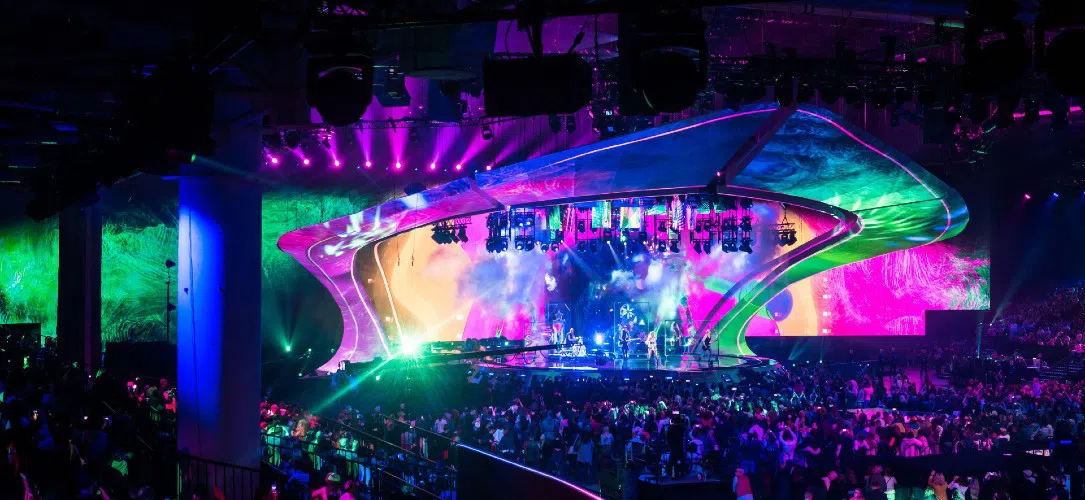
It was much simpler in terms of staging. It was more about making sure the artists felt comfortable with the sound, rather than focusing on staging or even the camera shots they were being given. The possibilities now are almost endless, and countries really do push that every year. I think the biggest challenge for the production company now is managing the expectations of countries that come in with these huge staging ideas. That’s definitely taken on a new lease of life, and it’s one of the things we all love watching and looking out for.
Did you see any celebrity attendees?
I think when the BBC hosted it back in 1998, they were strict with the ticketing, and if you didn’t have one, you weren’t getting in. It didn’t matter who you were, celebrity or not; you needed a ticket. That was good because then the focus was on the artists.
What do you think of our entry for this year?
Yeah, I think it’s a different strategy we’re going for this year. It’s definitely different! In my experience, the acts that tend to do better are often the kind of songs that are more like ‘anthems’ – the ones you might hear on RuPaul’s Drag Race. Those iconic, anthemic tracks that really stick and get picked up in LGBTQ+ clubs, where drag performers really make them their own. So whether this one ends up having that same kind of novelty or more of an anthem feel, I’m not sure. But it’s nice to try different things out. It definitely feels like a different offering to what we’ve done recently. But I don’t think it’s a winner for us.
Experience the thrill of our casino wherever you are. Get it today from the Play Store or the App Store and dive into a world of exciting games, big wins, and exclusive bonuses.