



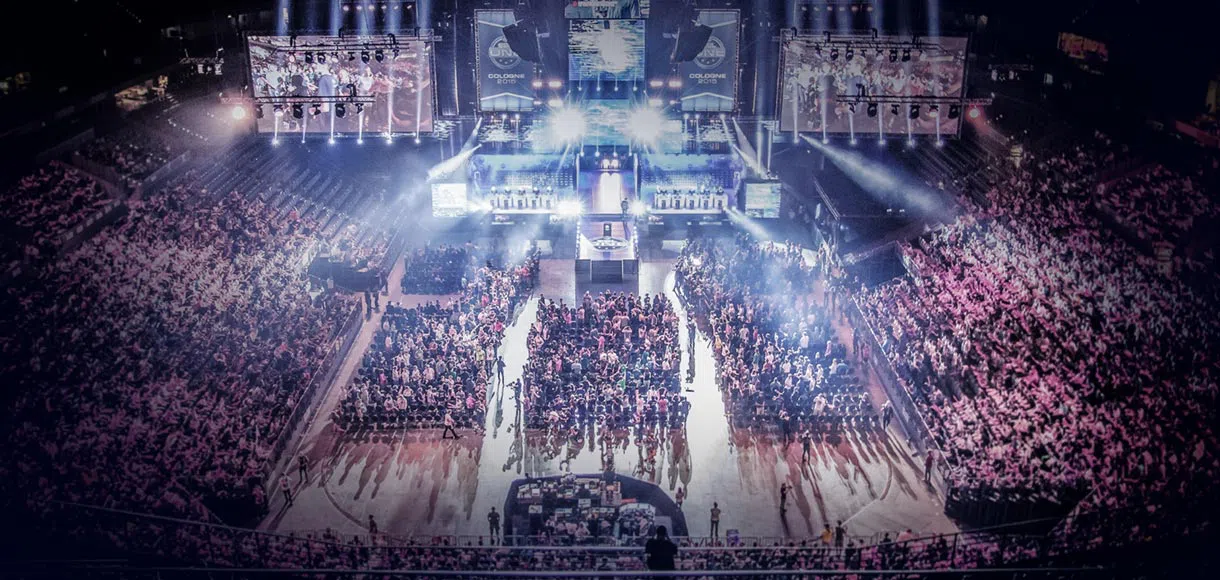
It has had challengers, including Yahoo eSports and YouTube Gaming, but Twitch is the big daddy of live streaming video game footage
Twitch is the big daddy of live streaming video game footage, particularly in the eSports community.
Recently it has had some challengers, including Yahoo eSports, YouTube Gaming, Azuba, Hitbox and Dingit.
Some are in their relative infancy, while others are seen as somewhat of a power grab by well-respected platforms moving sideways into a market.
So what makes Twitch the undeniably dominant platform of choice?
Audience
Clearly, a streaming platform lives and dies by its audience – and Twitch is at the forefront of it all.
Originally created as Justin.tv in 2007, the gaming arm spun off to become the Twitch we know and love today back in 2011.
Twitch was the first to be directly focused on the eSports scene, making it the forerunner – and they have certainly lead from the front in eSports streaming.
The first eSports event to break viewing records was back in 2012, when Riot’s Twitch stream of Season 2’s League of Legends World Championship was seen by a total of 8.2 million people, including a peak of 1.1 million streaming concurrently.
They then proceeded to break their own record by a landslide for the same event in 2013 – with 32 million viewers, 8.5 million at the same time.
If you want proof it’s a growing beast, 2014 had 288 million total viewers, 2015 an eye-watering – and needless to say, another record – 334 million viewers, with a high of 4.2 million tuning in at the same time.
Naturally, you could argue that this was on LoL Esports’ website, but the streaming platform was undeniably Twitch’s.
There are plenty of challengers for Twitch’s crown, but they will have to go a long way to amass the amount of dedicated viewers that Twitch has built up over the past few years.
They have achieved it through two key areas, investment and innovation.
Investment
During its peak hours, Twitch accounts for the fourth largest amount of traffic on the internet according to the Wall Street Journal, only surpassed by Netflix, Google and Apple. They recently leapfrogged Facebook.
This has been the norm for several years now. But let’s rewind, back to 2014.
Google seemed determined to corner the streaming market. In July, they acquired YouTube for $1.65bn to place it as the lynchpin of their new video empire.
Now, no-one is arguing that YouTube isn’t the biggest streaming platform. Even in 2014, they had numbers beyond the wildest dreams of any other platform in terms of video streaming and playback.
However, they were lagging behind specifically in the eSports section of video game content. And everyone assumed that was about to change.
There were constant industry rumours that Google was also going to purchase Twitch for around $1bn.
The rumours were so frequent that most people assumed it was a done deal. But the actual buy notice never surfaced.
A month later, at the same time that Twitch hit over 55 million unique monthly viewers, Amazon emerged as the new shock buyers of Twitch for $970mi.
The all-cash deal led to a new and improved Twitch platform, as well as the promise of serious advancements. Which leads us to the second key issue.
Innovation
All industries depend on innovation to keep moving forward – stagnation often proves the death knell of most.
The new investment of Amazon has enabled Twitch to create several new innovations, specifically introducing new eSports and a new game engine.
In addition to recently extending their partnership with the Electronic Sports League (ESL) – commonly acknowledged as the world’s largest eSports company – Twitch has used parent company Amazon’s reach and funds to partner with San Diego-based developer Psyonix to turn smash hit online game Rocket League into the next big eSport as the Rocket League Championship Series.
Thanks to the extra funding provided by Amazon, the new three-month series will be across the US and Europe with a $75,000 prize pot.
As an example, it shows how Twitch and other companies that benefit from the eSports explosion can keep the cycle spinning, by introducing new features that they hope will become ever more popular and expand the reach of eSports.
One would suspect similar ambitions are behind the release of Lumberyard, a cross-platform free 3D game engine that Amazon Web Services is handing out to PC and console developers to use however they like.
It is surprisingly rare for any engine creators to hand out test kits for a new engine, let alone unrestricted access to the source code.
But as the details make clear, “the platform includes hooks for game developers to incorporate the Twitch video streaming platform in their games so that players can, with a few keystrokes, invite spectators to vote on their next course of action or even to take over the game’s controls for a while”.
Thus, the innovation is clear. Amazon are offering developers the chance to create games which already have the Twitch platform built in, ensuring they get in on the ground floor of whatever the next big thing is and maybe, just maybe, turn that into an eSport as well.
Don’t forget, you can even predict League of Legends will be in the 2030 Winter Olympics at 80.00. Then Twitch really would be the future.
Twitch is, as we have seen, not alone in the video streaming market, but for now it is certainly the dominant platform for eSports content.
As long as the competitors can keep Twitch ‘honest’ and encourage them to support and expand the eSports community for at least a mixture of noble and self-sufficiency reasons, everyone benefits.
Everyone wins.
READ: Fantasy football? How famous eSports sides compare to their Premier League counterparts