In our exclusive interview, Sven Smeets discusses Formula 1's evolving regulations, the growing role of AI and the importance of team harmony in delivering success.
How do the Team Principal and Sporting Director work together day-to-day, and where do their responsibilities intersect?
James and I work very closely on a variety of topics. Take the race team for example, James is very close to them because he was himself part of the race team at Mercedes. So everything about pit stops, how we operate, procedures, he is very closely involved with. He provides loads of feedback after every weekend.
But he’s also very into new projects and he wants to know how those projects evolve, where we are with them, if we’re tracking on time, and of course, have a say on how
the layout and look will be. If I look a little bit further at the academy, again that’s a topic that James is very involved in. He wants to meet every driver that I propose to recruit. He gets weekly and monthly updates about the performance of our drivers.
As for the sporting aspect of my role, I’m part of the Sporting Advisory Committee. We meet with all the other sporting directors and team managers around every five to seven weeks where we discuss the current sporting regulations, look to if there are changes needed or if new rules need to be invented.
For example, as the cars and regulations change, advisors go to the F1 Commission, which James is also part of, to sign them off so that they become a real rule in our sports. Of course there is a lot of preparation for that to happen, and James is very much involved in going through the sporting regulations. Those are the three key areas where we work together on a daily basis.
When a major regulation change is announced, what’s the very first question you ask as a Sporting Director?
You can look at it in many ways. First of all, how many sporting regulations have to change to accommodate the new car, as energy management has been a very big topic from the start of this year. A lot of rules were introduced to handle that in the races and we’re still adapting them. There is also a new set of rules coming for next year.
But if you just look at the sporting side of a new car, it also affects, which many people probably don’t think about, things that we do in logistics. For example, the front wings changed dramatically, which meant that we had to change all our air freight boxes to incorporate them.
So as soon as new regulations come, it impacts the sport itself but also has an effect on how we operate.
How do you decide where to place your first major development bets when there’s no real-world data yet?
As a race team, we’re involved a little bit later. But if I take it from when new regulations come out, we start with a small concept group, normally led by a chief engineer, which allows us to come up with several concepts. From there the group becomes bigger – more engineers get involved, and concepts will become things on paper.
You can then go to the wind tunnel to start simulations, and from there you start to create your first car. You then start to go into the driver simulator. You will ask your F1 drivers and development drivers to come along to drive that car in the simulator. From then on, it’s about trying to improve on that until you reach the first test.
But it is very difficult and that’s why the first test is so important. That gives you your first set of data, which you can correlate back to what you had during simulations. From there you can try to have a plan to make the car faster and faster throughout the year.
Formula 1 is often described as a combination of driver talent, engineering excellence, and team execution. How would you describe the balance between these factors when delivering strong results on track?
It’s a very interesting one because you would say everything depends on the car. But we have seen in the past that the strongest car doesn’t always give you the Championship because you need a very strong team execution throughout the year in 24 races, and you need to have the driver to do that.
I would say it is about harmony and if you’re looking at it in percentages then 30-30-30 would be an ideal mix – that would mean you have everything. But sometimes it could be that a car was so dominant that it’s maybe not the most talented driver that becomes a champion.
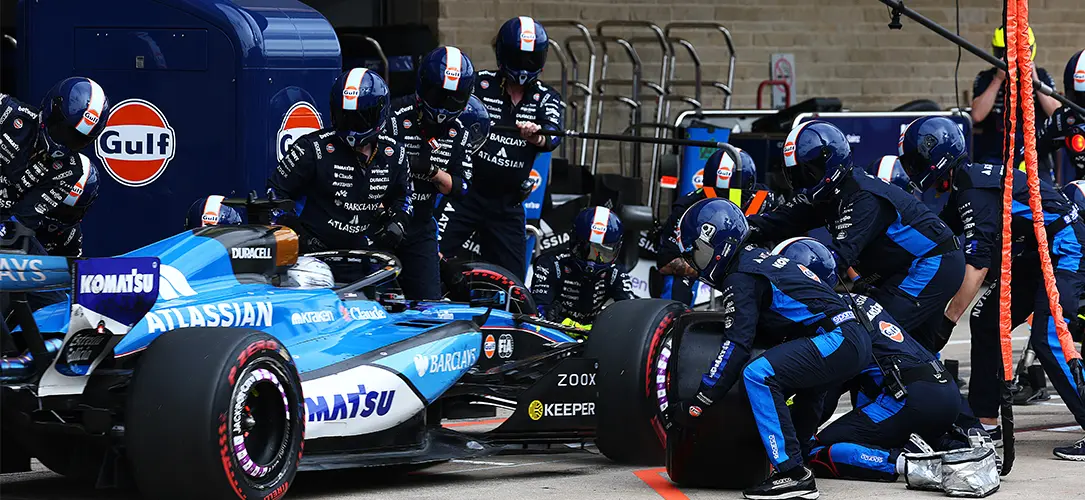
I think team execution is something that needs to stay very stable because it has a direct impact on your results. If there is poor team execution with pit stops for example, with them being five seconds long and not two seconds, it can make you lose races even if you have the best driver and the best car. So I would say it’s about trying to achieve the perfect harmony.
You gave Luke Browning FP1 duties in Spain and Austria. How different is the adjustment for a young driver stepping into a car with active aerodynamics compared to previous generations of machinery?
Luke is testing with last year’s car. He’s done about six or seven days this year on different tracks, just getting used to driving an F1 car and trying to make everything feel automatic. Of course, he’s driving the simulator nearly every week.
But the hour that he got in Spain and Austria is still something that is very difficult. You can prepare as much as you can, but it is only by doing it that you learn the most. So I’m very happy, he will also do Mexico and Brazil as his next two outings. That will be four times in the car, which will allow him to get stronger and stronger.
Unfortunately, they can’t drive the real car [outside of FP1] because it’s not allowed by the sporting regulations. So the simulator is where he tries to compensate for not driving the car every other week.
How has your approach to managing the sporting and operational side of the team changed as the reliance on data-driven decision-making has grown?
The introduction of AI is growing rapidly in our company and I think this will just speed up in the years to come.
Before it was based on the experience of people, but now there is so much more data available. So people that maybe haven’t been in the sport for 30 years can make that same decision that 20 years ago only certain people could make.
It’s really good to see because it means that you don’t need to build a career of 30 years to be in a more decision-making role.
But we’re using AI more and more. I use it in the academy to create performance reports on a driver, where before I needed an engineer spending a day getting all the results of simulators and races. Now that we have all the data in one place with some of our partners’ tools, it’s very handy.
What are the biggest challenges you face when balancing the team’s rigorous data requirements with the practical, real-world needs of the trackside team?
As an example, it is still true that for engineers to have the real experience, despite having a lot of data and practice in simulators, they need that track experience. There is one thing data can’t do and that is replicate the pressure of a track environment. Decisions need to be made there and then based on something that you have in front of you. There is no time to think, especially during the race. Decision making has to be instant.
The pressure of being trackside and being in that scenario is probably the only thing that you need to learn.
We use our test programme a lot to bring junior and young engineers into that environment. But with that they maybe have a bit more time to think without the pressure of performing or needing to win a race. But I do think the real world is still very important for the development of people.
With more races and a growing global audience, how challenging has the F1 calendar become from an operational perspective?
I think with the 24 races that we have and the one or two tests, along with the two or three tyre tests that nobody really sees, I think we’re sort of at the maximum capacity.
Like with myself and many others, if you do all the races then it is challenging with family life and actually keeping yourself in very good health. Importantly, to perform under pressure you need to be in good health, and of course family is the most important thing in life. Trying to balance all that out, I think 24 [races] is the maximum we can do.
What’s the best part of your job, and what’s the toughest?
The best part of the job is that we are in a sports team that has one goal, and that is becoming World Champion one day – and we’re all working very hard to achieve that. To get that feeling one day with a group of people would be the best feeling ever because Formula 1 is definitely a team sport.
But that comes with the other side of the medal, which is that you need to spend a lot of time in this sport. As I said, family life does suffer. But trying to find that balance, which is not very easy and is probably not for everybody, is probably the hardest part of our sport.
Visit Betway’s F1 betting page for all the latest odds, markets and specials.