



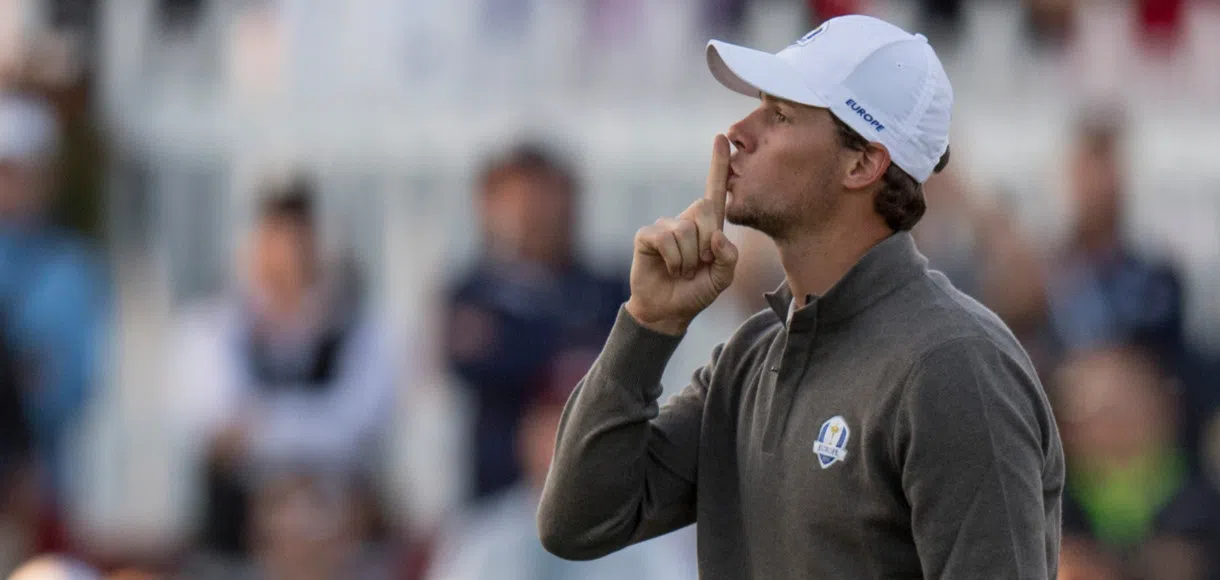
Pieters and Cabrera-Bello led a group of talented debutants that were underused by European captain Darren Clarke...
“I believe that we will win,” chanted the American galleries at the start of the Ryder Cup’s final day.
While not the wittiest ditty, they were right. The result, if we’re honest, was never really in doubt.
The hosts sunk more putts and were relentlessly consistent over the course of a majestic weekend at Hazeltine – a superiority reflected in the final score of 17-11.
Europe, meanwhile, played exactly like what they are: a team in transition.
The visitors can draw positives, however, from their blend of inexperienced young players and Ryder Cup stalwarts competing with an excellent American team.
Two rookies in particular showed the ability and resolve to become future Ryder Cup greats.
Thomas Pieters, a wildcard pick of Darren Clarke’s, was the tournament’s most prolific player.
After a quiet start in the opening-day foursomes, the 24-year-old flourished alongside a fired-up Rory McIlroy, winning three points as a pair over the first two days.
Pieters then dominated J.B. Holmes in the singles to become the first European rookie ever to earn four points on his debut.
Not only was he not fazed by the hostile atmosphere on the course, it actually seemed to spur him on.
Usually understated on the course, the Belgian enjoyed a few fiery fist-pumps of his own as he and McIlroy sunk putts from all over Hazeltine’s lightning-fast greens.
He is a major-winner in the making, and the prospect of him partnering the Northern Irishman in future Ryder Cups is thrilling.
Theirs wasn’t the only formidable European pairing forged over the weekend, though.
Spaniards Sergio Garcia and Rafael Cabrera-Bello dovetailed perfectly, with the latter going unbeaten and earning two-and-a-half points over the weekend.
The world No. 30 was considered a potential weak link for the Europeans, having failed to win a European Tour event since 2012.
But Cabrera-Bello was one of the few players who truly excelled themselves.
He and Pieters led a group of rookies that were, in truth, underused by European captain Clarke.
Instead, the Irishman relied upon the old guard – Lee Westwood, Martin Kaymer, Justin Rose and Henrik Stenson – who have given the team so much in past Ryder Cups.
This is 2016, though, and former triumphs counted for little against the hungry Americans.
Clarke’s trust in the team’s elder statesmen was misguided, considering how poorly the majority played both before and during the tournament.
Westwood, picked to bring experience to such a young side, choked with the putter and lost all three of his matches.
Kaymer, meanwhile, fell to three defeats before picking up a meaningless victory in the singles.
Rose and Stenson each earned two points from five matches, but considering the Englishman’s putting woes and the Swede’s injured knee, they both needed a rest.
With two of his six debutants performing so convincingly across the three days, Clarke should have put more of his trust in the team’s younger talent.
Andy Sullivan and Matt Fitpatrick were punished for occasional mistakes in the foursomes and benched until Sunday, which made winning their singles an even more daunting task.
Chris Wood, who was very tidy in a Saturday foresomes win and a tight singles defeat to Dustin Johnson, deserved more action, too.
They can provide the foundation for future sides, led by the inspiring McIlroy – a transcendent talent who elevated his game to even higher levels in this competition.
Europe’s run of three consecutive Ryder Cups is over, and only evolution can extend their recent dominance of the event.
In Pieters, Cabrera-Bello and the other rookies, though, they have a steady-handed group ready to absorb the load.