



Learn the winners of the World Cup Golden Ball. Discover who’s won the Silver Ball and Bronze Ball and how often the Golden Ball goes to the tournament winner.
Presented to the best player at the end of every World Cup tournament, the Golden Ball is a huge honour for any player to receive. Being recognised as the best player in a competition filled with the greatest footballers from around the world is an accomplishment not many can say they’ve achieved.
But who are the winners of the Golden Ball since its introduction?
This blog will cover every winner of the Golden Ball, the nations that have won it the most, the winners of the Silver and Bronze Ball, and more! Read on for the full breakdown, or explore even more World Cup news and insights from Betway. Or, if you’re already predicting greatness this time around, discover the latest World Cup betting odds for each of the tournament’s matches.
When was the Golden Ball award introduced?
The introduction of the Golden Ball was at the 1978 World Cup, with the Silver Ball and Bronze Ball also being awarded for the first time here too.
What are the Silver Ball and Bronze Ball?
Similarly to how the Golden Ball is awarded to the best player at the tournament, the Silver Ball and Bronze Ball are given to the players ranking second and third in the voting for the main award.
This means that they are considered as the second and third best players at the tournament.
Who have been recognised as the best players at the World Cup over the years?
Below is a table breaking down the winners of each award since its introduction, highlighting the nationality of the Golden Ball winner:
Year | Golden Ball | Silver Ball | Bronze Ball | Nationality of Golden Ball winner |
1978 | Mario Kempes | Paolo Rossi | Dirceu | Argentina |
1982 | Paolo Rossi | Falcao | Karl-Heinz Rummenigge | Italy |
1986 | Diego Maradona | Toni Schumacher | Preben Elkjaer | Argentina |
1990 | Salvatore Schillaci | Lothar Matthaus | Diego Maradona | Italy |
1994 | Romario | Roberto Baggio | Hristo Stoichkov | Brazil |
1998 | Ronaldo | Davor Suker | Lilian Thuram | Brazil |
2002 | Oliver Kahn | Ronaldo | Hong Myungbo | Germany |
2006 | Zinedine Zidane | Fabio Cannavaro | Andrea Pirlo | France |
2010 | Diego Forlan | Wesley Sneijder | David Villa | Uruguay |
2014 | Lionel Messi | Thomas Muller | Arjen Robben | Argentina |
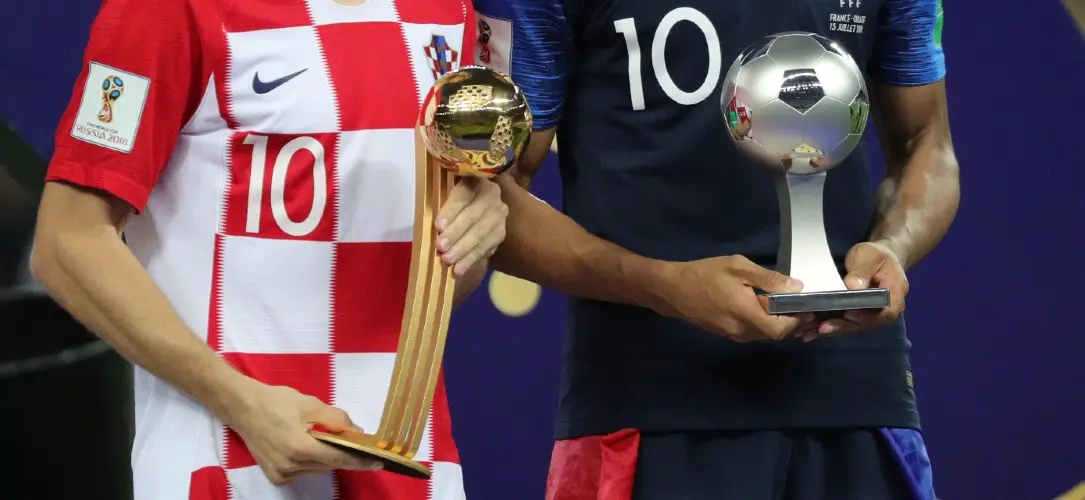
2018 | Luka Modric | Eden Hazard | Antoine Griezmann | Croatia |
2022 | Lionel Messi | Kylian Mbappe | Luka Modric | Argentina |
2022
Lionel Messi rightly won the Golden Ball for a second time, playing a massive role in Argentina’s third World Cup title, and first since 1986. Producing seven goals and three assists across the tournament, he provided a lot to Argentina’s attacking output. As he also scored twice and put away his penalty in the shoot-out during the final, his crucial contributions cannot be denied.
The Silver Ball was then awarded to Kylian Mbappe, who some would argue deserved the Golden Ball ahead of Messi. Finishing as runner-up after winning the Golden Boot with eight goals, Mbappe was pivotal to France’s good performances throughout the competition as he got two assists as well. Becoming only the second ever player to score a hat-trick in the final since Geoff Hurst, he’s become part of a very limited club.
Finally, the Bronze Ball went to Luka Modric, Croatia’s midfield maestro. Helping his nation to the semi-final, Modric was a central figure in their successful run at the tournament. Though falling short against Argentina at this stage, he contributed to their 2-1 win over Morocco in the third-place play-off.
2018
With Croatia beating the odds by reaching the final and becoming runners-up, Luka Modric was awarded the Golden Ball. Throughout the tournament, he was able to produce two goals and one assist, including a rocket against Argentina in the group stage. With standout performances such as when he orchestrated the game against England in the semi-final, he performed a level above other competitors for the award.
Belgium’s Eden Hazard was then given the Silver Ball after finishing third, following a 2-0 win over England in the third-place play-off. Across the competition, he racked up three goals and two assists, including in the third-place play-off final where he scored the second to seal the win.
Then, World Cup winner Antoine Griezmann won the Bronze Ball after finishing second in the top scorers’ list. With four goals and two assists, he made critical contributions to France’s second-ever victory at the tournament. He made important contributions such as scoring a penalty to put France 2-1 up against Croatia in the final and netting the second in their 2-0 win over Uruguay in the quarter-final.
2014
Winning the Golden Ball for the first time, Lionel Messi finished the 2014 World Cup as runner-up after losing the final 1-0 to Germany. Accruing four goals and one assist in his seven appearances, the Albiceleste had him to thank for going as far as they did at the tournament.
The Silver Ball was then won by World Cup winner Thomas Muller, who finished second in the goalscoring charts with five goals. Having also assisted three goals during the tournament, Muller demonstrated that he had many layers to his game and made huge contributions to Germany winning their first World Cup since 1990.
Dutchman Arjen Robben was then given the Bronze Ball as the Netherlands ended the competition in third place. Robben scored three times and got one assist, turning up for his nation in crucial moments. All three of his goals came in the group stage, but he was able to score important penalties in two shoot-outs even if his second couldn’t help the Dutch overcome Argentina.
2010
Uruguayan striker Diego Forlan was awarded the Golden Ball at the 2010 World Cup as his national team reached the semi-finals. Throughout the tournament in South Africa, Forlan finished on five goals, making him the joint top scorer at the competition with Wesley Sneijder, David Villa, and the Golden Boot winner Thomas Muller.
Dutch midfielder Wesley Sneijder received the Silver Ball at this World Cup after scoring five goals and getting one assist, contributing to the Netherlands finishing as runner-up against Spain. These goals included winners against Japan and Brazil, alongside crucial goals against Slovakia and Uruguay.
Spanish striker David Villa then finished his World Cup campaign with the Bronze Ball following on from his tournament win. His five goals and one assist were imperative to Spain’s success, as he scored three goals in the group stage, and grabbed winners against Portugal in the round of 16 and Paraguay in the quarter-final.
2006
Legendary French midfielder Zinedine Zidane earned himself the Golden Ball at the 2006 World Cup, despite his controversial sending off in the final. Finishing the campaign as runner-up, Zidane was unfortunate not to have won after his exploits, scoring three goals and getting one assist. His midfield leadership and memorable moments such as his Panenka penalty in the final meriting him the recognition.
Italy’s captain and star defender Fabio Cannavaro received the Silver Ball after winning the World Cup in 2006. His ability to lead his team, put in top defensive performances, and read the game, allowed him to keep five clean sheets. His displays earned him the nickname ‘The Berlin Wall’ as he was a defensive rock throughout the tournament in Germany.
Also a World Cup winner, Andrea Pirlo was awarded the Bronze Ball after racking up one goal and three assists across the campaign. Highlighting his tournament were moments such as scoring a rocket against Ghana in the opening game, scoring an elite free-kick assist against the USA, and slotting home a penalty in the final shoot-out.
2002
A unique feature on this list, Oliver Kahn is the only goalkeeper in history to win the Golden Ball. He received 147 votes, giving him 21 more than Ronaldo who won the tournament and scored twice past the German goalkeeper in the process. Kahn managed five clean sheets and won the Golden Glove as well, making him a deserving winner of the award.
After netting eight times and winning the tournament, the 2002 World Cup saw Ronaldo leave with both the Silver Ball and the Golden Boot. The Brazilian striker scored in every game except for their 2-1 quarter-final victory over England, with two of his goals coming in the final. His incredible scoring record made it hard to ignore his elite performances during the campaign.
Spearheading South Korea’s run to finish in fourth place, Hong Myungbo was a key player in the Asian nation’s success at the 2002 tournament. The centre-back was a commanding presence in the team, also managing to score a crucial penalty in the shoot-out against Spain in the quarter-final.
1998
Though losing the final 3-0, Brazil’s number nine Ronaldo was the recipient of the Golden Ball in 1998. The 21-year-old managed a staggering four goals and three assists in his seven appearances, being at the forefront of Brazil’s stellar campaign.
Croatian Davor Suker earned himself the Silver Ball after leading his national team to finish in third. He accrued six goals over the course of his seven appearances, with the 30-year-old managing winners against Japan, Romania, and even the Netherlands in the third-place play-off game.
Finally, the Bronze Ball was given out to the World Cup winning Frenchman Lilian Thuram. The right-back produced two goals and one assist in France’s first ever World Cup win, keeping five clean sheets as well. His defensive capabilities along with his crucial output going forward in the semi-final game against Croatia showed why he deserved the award.
1994
At 28 years old, Romario managed to win the 1994 Golden Ball after becoming a World Cup champion with Brazil. Across the tournament, he found the back of the net five times and got two assists, with three of his goals coming in the first three games. Considering he also scored the winner against Sweden and converted his penalty in the shoot-out during the final, he certainly impressed.
Narrowly losing in the final on penalties, Italian forward Roberto Baggio received the Silver Ball for his displays throughout the 1994 tournament. Despite not getting any assists and not scoring in the groups, Baggio came alive in the knockouts. He scored twice in a 2-1 win over Nigeria, got the winner against Spain in the quarter-final, and scored both goals in a 2-1 win over Bulgaria in the semi-final, totalling five goals in his seven appearances.
The Bronze Ball was then awarded to Bulgarian striker Hristo Stoichkov. The 28-year-old racked up six goals and one assist in his seven appearances, helping Bulgaria to the semi-finals and to finish in fourth overall. Some of his most important goals came against Argentina, Mexico, and Germany, as Bulgaria’s fairytale run was fuelled by his finishing abilities. Despite scoring against Italy in the semi-final, a Roberto Baggio double meant it wasn’t enough.
1990
The 1990 Golden Ball winner was Salvatore Schillaci, Italy’s surprise star striker of the tournament. Having only made his debut for Italy earlier in the year, nobody expected him to win the Golden Boot with six goals. Despite not winning the tournament, Schillaci scored multiple game-deciding goals such as a headed winner against Austria in Italy’s opening game and a late penalty against England to finish in third place.
The Silver Ball was then given to Lothar Matthaus, who captained West Germany to World Cup victory. The defensive midfielder put in many impressive displays, scoring four goals in his seven appearances, including a winning penalty against Czechoslovakia in the quarter-final. The midfield maestro demonstrated elite leadership alongside remarkable stamina and passing skills.
Then the Argentine magician Diego Maradona received the Bronze Ball, helping his nation to finish as runners-up. Though he didn’t score, his influence was still felt on the pitch as he managed to get two assists and terrorised defenders with his top-class dribbling abilities.
1986
Dominating the whole tournament, Diego Maradona almost single-handedly won Argentina their second ever World Cup. The 25-year-old attacking midfielder scored five goals and managed five assists, with multiple standout moments. This especially includes his memorable performance against England, where he scored the ‘Goal of the Century’ after dribbling past the Three Lions’ defence from his own half!
Finishing as runner-up after losing to Argentina, West German goalkeeper Toni Schumacher managed to earn the Silver Ball. He kept three clean sheets and only conceded seven goals in seven appearances, playing every minute of the tournament.
The Bronze Ball was received by Preben Elkjaer, who helped his nation, Denmark, to reach the last 16. Despite only managing to make four appearances at the 1986 World Cup, Elkjaer scored four goals and got two assists in this short time. His contributions played a huge role in Denmark topping the so-called ‘group of death’ containing West Germany, Uruguay, and Scotland.
1982
Helping Italy to become champions, forward Paolo Rossi earned himself the Golden Ball. He scored six goals and got one assist in his seven appearances, including a hat-trick against Brazil in the quarter-finals. One of his most important goals came against West Germany in the final as he opened the scoring. His efforts in front of goal earned him the Golden Boot, and his 1982 World Cup campaign is one that lives in the memory of Italian fans around the globe.
The Silver Ball was then given to Brazilian Falcao who helped inspire his nation to progress to the second group stage. The central midfielder managed to get three goals and one assist in his five appearances, scoring a stunning goal from outside the box against Italy in the second group phase.
Karl-Heinz Rummenigge contributed massively to West Germany finishing as runners-up, winning him the Bronze Ball. The 26-year-old forward made seven appearances and scored five times, with his most important goal coming in a drama-filled 3-3 semi-final clash against France.
1978
As he made huge contributions to Argentina winning their first World Cup, attacking midfielder Mario Kempes won the Golden Ball. The clinical nature that he displayed throughout the tournament saw him claim the Golden Boot as well, scoring six goals with two of them coming in the final against the Netherlands!
The 21-year-old Italian Paolo Rossi helped his national team to finish the 1978 tournament in fourth and won himself the Silver Ball. His goalscoring instincts were clear for all to see as he managed to get three goals and two assists. With important goals against France and Hungary in the first group stage and getting the winner against Austria in the second group stage, Rossi was a key figure for Italy’s attack.
Attacking midfielder Dirceu then received the Bronze Ball after finishing third with Brazil. Throughout the 1978 campaign, the 25-year-old scored three times, and played every minute of Brazil’s seven matches. His best game was no doubt against Peru, where he scored twice in a 3-0 win, but his biggest goal was the winner in the third-place play-off match against Italy.
How often does the Golden Ball award go to a World Cup winning player?
Out of the twelve times that the award has been given out, only five occasions have seen the winner be a World Cup champion as well. This happened with Mario Kempes (1978), Paolo Rossi (1982), Diego Maradona (1986), Romario (1994), and Lionel Messi (2022). So, although the first three winners of the award were World Cup winners, since then the trend seems to lean towards runners-up in the tournament, or semi-finalists instead, with this being the case seven times.
Has anyone won the Golden Ball award more than once?
Only one player has managed to win the Golden Ball more than once, Lionel Messi. First receiving it after his impressive performances in 2014 as runner-up, he managed to claim the award again in 2022, winning the tournament this time round.
Which nations have the most Golden Ball winners?
Though players from seven different countries have won the accolade, the Golden Ball has been won by Argentina the most.
Three separate Argentine players have been given the award, with Mario Kempes (1978), Diego Maradona (1986), and Lionel Messi (2014, 2022) receiving it. As Messi has won it twice, however, Argentina have won the Golden Ball four times in total.