It's a simple enough game, chuck three slivers of metal into a board, count up the score, subtract it from your previous score until you reach zero via a double.
Simple yes, but it wouldn’t be sport without a panoply of words, phrases and buzz terms, some of which are self-explanatory, some which make precious little sense at all, but all of which add to the pageantry and mystique of the game.
So welcome to the world of the madhouse, bed ‘n’ breakfast and the big fish and other wonderful additions to the darting glossary.
Nine-darter
So let’s start with the holy grail of darts, the nine-darter.
There is no secret here; this is when a player completes a leg of 501 in nine darts, the minimum number of darts required to do so. It needs eight high-value trebles and a finishing double to pull off and remains a rarity.
The first televised nine-darter was pulled off by John Lowe in 1984, six years before Paul Lim became the first player to do it in a World Championship.
Luke Littler is the youngest to do the feat on TV – he was two days shy of his 17th birthday when he managed it at the 2024 Bahrain Masters.
Phil Taylor has done it 11 times on TV, more than any other player.
Big fish
If the ‘magic nine’ raises roofs at darts events, then so too does the big fish, which is the 170 finish, the highest possible single visit checkout to win a leg.
It requires two treble 20s and the bull’s eye and world champion Littler, notably, celebrates hitting it by pretending to cast a fishing line to catch, you guessed it, the big fish.
Champagne shot
Specifically a 132 checkout, and even more specifically achieving it by going outer bull (25), treble 19 (57) and bull (50).
Depending on how the first dart is sitting in the outer bull will determine the difficulty of the challenge of nailing the bull with the third dart. And that, of course, presumes the treble 19 has been hit.
Bullseye
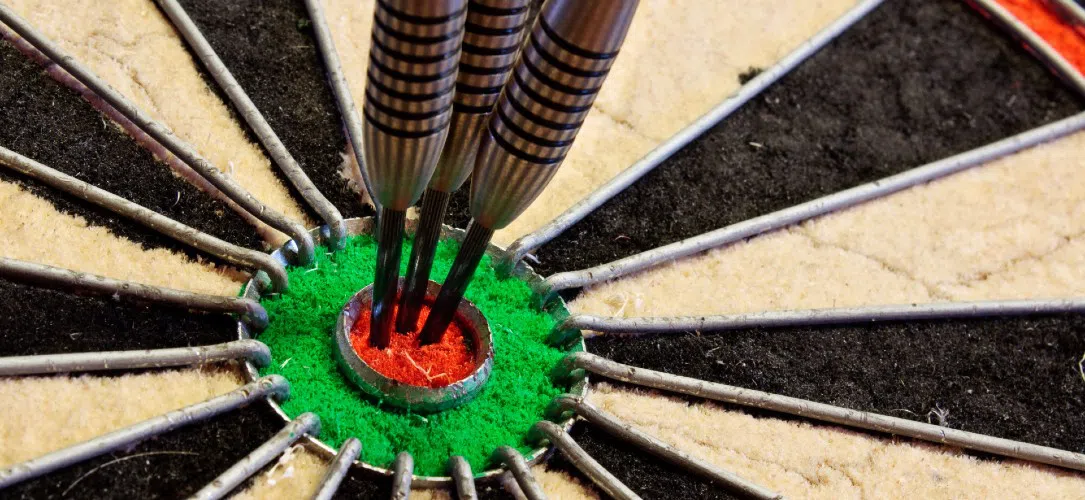
Talking of the bullseye, that’s the very centre of the board, a circle with a target diameter of 12.7mm.
Maximum
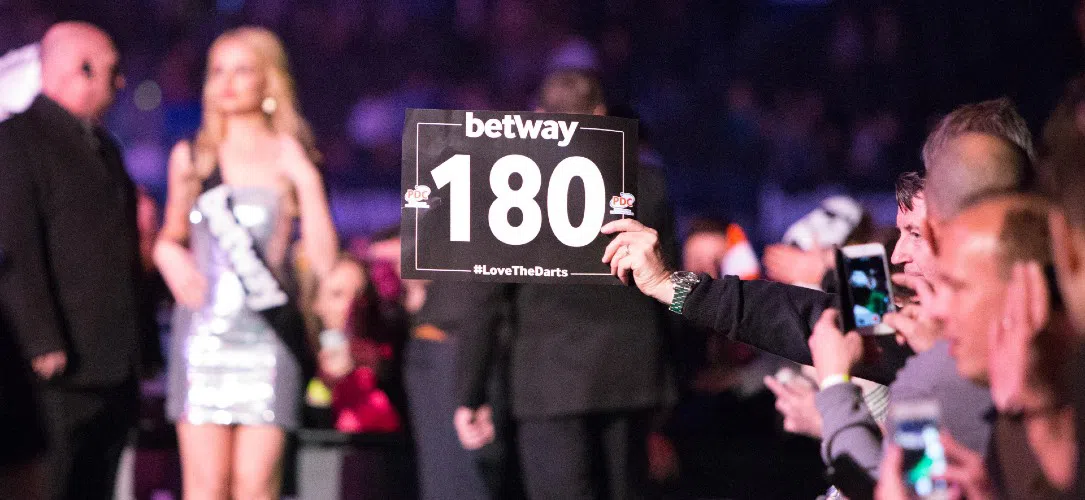
A single-visit score, the highest single-visit score in the game, achieved only by hitting three treble 20s. On TV, gets the telltale roar of “ONE HUNDRED AND EIGHTY” from whoever is calling the scores.
Lipstick
And if you do that, you’ve filled the lipstick, the treble 20 bed often being referred to thus because it is usually red in colour.
Shanghai
The Shanghai finish is scoring a single, treble and double of the same number to win a leg. So, a 120 checkout could be achieved by hitting treble 20 (60), plus single 20 (80) and finally double 20 (120).
It works on any combination of any number. Back in the day, a popular way of taking out 96 used to be treble 16 (48), plus single 16 (64) and finally double 16 (32 to equal 96). Shanghai on 16s.
As for the origin of the name, there are several possibilities, none of which seems to have ever been confirmed. If that helps!
Oche
While we’re on one-worders, don’t forget the oche, the line from which players throw, 7ft 9-and-a-quarter inches from the board.
Again, the origin is unknown, though it is unquestionably a shortened version of the word hockey.
Bed ‘n’ breakfast
And so to a trio of terms which will mean plenty to recreational darters, the first of which is bed ‘n’ breakfast, which is used to describe the score 26 when it is compiled by scoring single 20 and its neighbouring beds, single one and single five.
The original description for that score was two-and-six, or two shillings and sixpence, which was an accepted price for bed and breakfast in past times.
Madhouse
Another mildly insulting phrase which weekend chuckers will have heard is the madhouse, which is being left with Double One to finish a leg.
Probably called the madhouse because it’s maddeningly awkward being on it knowing any dart thrown too low will bust your score.
Bag o’ nails
And finally, while we’re talking less competent dartsmanship, the bag o’ nails, which is scoring exactly three courtesy of three darts in single one.