




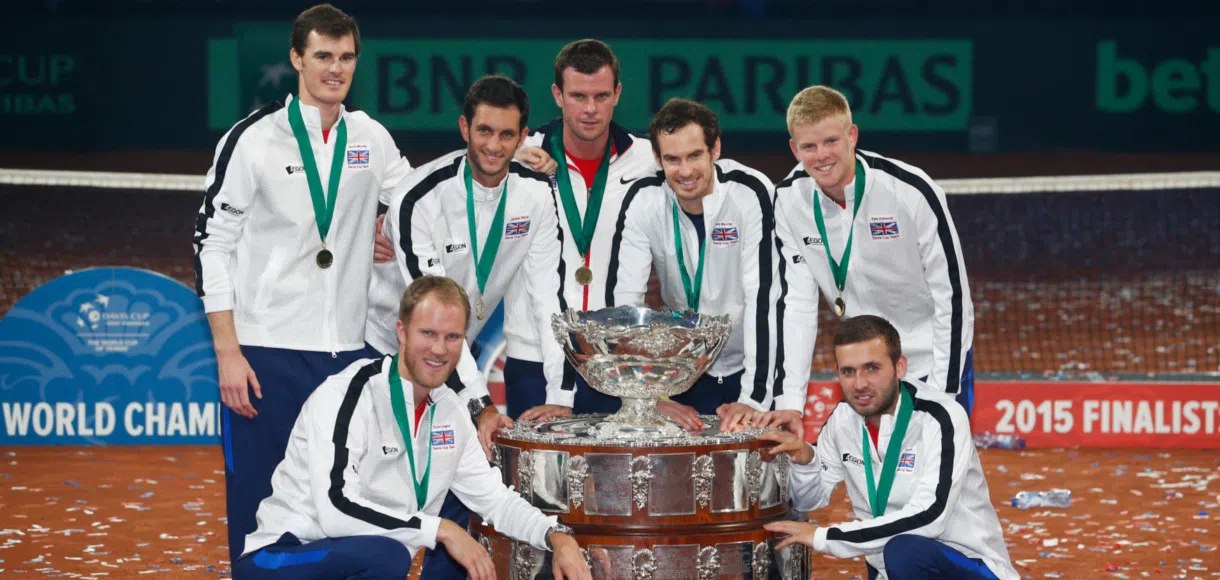
British tennis' strength-in-depth boom has emerged in the aftermath of the Davis Cup victory – with the Scot spending increased time with his compatriots...
Travelling, training and living with one of the all-time great British sportsmen must prompt rapid development.
Professional standards rub off, and the ability to work for that winning habit is cultivated.
Improvement beyond what might otherwise have been possible is a certainty.
Such a scenario, therefore, is a clear explanation for the ascent of Dan Evans and Kyle Edmund.
Were Evans – the higher ranked of the two – British no.1, pressure and expectation would have been significantly higher.
Instead, the pair have picked the perfect period of time to become British tennis’ best of the rest.
To those familiar with Andy Murray’s ferocious game-face, it will come as little surprise that the same competitive attitude is exemplified to those around him in everyday life.
Murray spoke from New York last week of his training relationship with his fellow Brits.
“What I like most about practising with them is I have a responsibility to work hard and push myself”, he said.
“When I’m on the court with them, I really want to work hard and show that this is what you have to do.
“Maybe if it was with someone from another country, I wouldn’t feel the same.”
Such a mentality has you wondering whether the world no.2 would even go below 100 per cent while playing with his baby daughter in the back garden, let alone fellow professionals.
Not that Murray can be credited exclusively with the pair’s excellence.
In 2011, Edmund reached the semi-finals of the boy’s competition at Flushing Meadows, while he also won two junior doubles grand slams in subsequent seasons.
Evans, meanwhile, has seen his progress stunted by a lack of true commitment.
In 2013 – while ranked 325th – he openly admitted to not working hard enough after Davis Cup defeat.
Not to mention June 2015, at Wimbledon, when he was warned by the on-court umpire for not trying hard enough at the end of a set he was comfortably losing.
A lovable character, perhaps, but given that he looks set to break into the top 50 at the end of this competition – he was some way from doing himself justice with a ranking of 750 last summer.
Last season’s successful Davis Cup campaign, therefore – including intensive work with Murray – has surely proved the catalyst for Evans to reach the third round at both Wimbledon and in New York this year.
Indeed, he was just one point away from knocking third-seed Stan Wawrinka out of the latter competition.
In combination with Edmund – who went one better and reached the fourth round before defeat to Novak Djokovic – Britain’s Davis Cup squad for their semi-final tie with Argentina looks powerful.
Those reserves will be further exaggerated if Murray chooses not to play in the doubles, as one of Evans and Edmund would miss out.
Deciding which player ranked inside the top 50 to drop – if such a situation arises – is a tough call.
But it’s one that previous beleaguered Davis Cup captains will envy.
Furthermore, that James Ward is nowhere to be seen reflects the number of options suddenly available.
All of which is testament to the talismanic status that Murray has assumed.
It disproves concerns that the Scot lacks the charisma and influence to have an impact on the landscape of British tennis.
The strength-in-depth boom has emerged in the aftermath of the Davis Cup victory – and Murray spending increased time with his compatriots.
No coincidence.
Progression to a second successive final, therefore, is an achievable goal.