

There have been plenty of Scots who have starred in the Ryder Cup for Great Britain and Europe down the years and here we profile some of the most memorable.
Robert MacIntyre was the proudest Scotsman in Rome two years ago, where he showed all his fight and courage helping Europe crush the United States to win back the Ryder Cup.
The left-hander from Oban, a renowned tough cookie on the DP World Tour, now needed to show his mettle at the Marco Simone Golf and Country Club in one of the most intense theatres in any sport. On his debut.
Many have folded in that crucible; MacIntyre flourished.
Twice teaming up with Justin Rose to win a point and another half point over the first two days, MacIntyre then brought the team home on the Sunday afternoon with a tidy 2&1 win over Wyndham Clark, going unbeaten to tee up European celebrations long into the night.
Scotland has had its Ryder Cup heroes down the years, the likes of Brian Barnes, Bernard Gallacher, Sandy Lyle and Mr Ryder Cup himself, Colin Montgomerie.
The man they call Bob Mac is the latest to join the biennial team event’s tartan army and share in Scotland’s rich and proud tradition of involvement in one of the world’s great sporting stories.
George the First of Scotland
A total of 22 Scottish players have graced the last century of Ryder Cup combat.
Not all of those grew up in Scotland yet someone like Sandy Lyle may have been born in Shrewsbury but he has tartan running through his veins.
And there should have been 23 except the luckless Stewart Burns, despite being picked for the second Ryder Cup in 1929, was omitted at the last moment as triumphant Great Britain captain George Duncan slimmed his 10-man group down to eight.
Two years earlier Aberdeenshire-born Duncan, the 1920 Open champion, was part of the inaugural Team GB who flew out to Worcester Country Club for the first Ryder Cup.
Duncan contributed his side’s only singles point – beating Joe Turnesa 1-up – in a thumping overall loss, before becoming the first of only three British captains to lift the Ryder Cup at Moortown two years later, with Ryder himself presenting the Scot the trophy.
Houston, we have a problem – so call in the Scots
Scotland’s role in the Ryder Cup was virtually non-existent in the three editions prior to the Second World War, and even after hostilities on the battlefield ended and hostilities on the fairways resumed, the ‘home’ team had a very English look to it.
The team that went to Houston in 1967, for example, had just one Scotsman, George Will, travelling with the likes of Tony Jacklin, Peter Alliss and Neil Coles to tackle an American side spearheaded by the mighty Arnold Palmer.
The Americans would win 23.5-8.5, the heaviest defeat ever suffered by the Brits who knew change was needed.
Two years later and two Scots appeared in the team at Royal Birkdale. Brian Barnes, who didn’t win a point, and Bernard Gallacher, a 20-year-old rookie and the youngest player to play in the event up to that point.
Gallacher took to the heat of battle like a duck to water – and it was a battle, a very bad-tempered battle at times. Gallacher loved it, claiming two points including a stunning 4&3 demolition of Lee Trevino, in a competition overshadowed by animosity and ill-feeling though ultimately remembered for the famous concession on the last between Jacklin and Jack Nicklaus.
Gallacher inspires Cup to new heights
The ’69 Ryder Cup finished 16-16, a moral victory for Great Britain just two years after the hammering in Houston.
Gallacher was certainly inspired being GB’s top scorer with 3.5 points – albeit in a losing cause – in St Louis next time out and was still a key member in 1979 when new life was breathed into the event as Great Britain became Europe.
Indeed, Gallacher was outstanding that year in St Louis, utterly upstaging newcomer Severiano Ballesteros and everyone else, registering four of Europe’s 11 points, including a handsome 3&2 triumph over Lanny Wadkins.
By the time Gallacher played his eighth and final Ryder Cup in Florida in ’83, a new wave of Scottish players was emerging, among them Lyle, Sam Torrance and Ken Brown.
Indeed, Torrance soon entered tournament folklore, standing on the 18th green at the Belfry in 1985, arms outstretched after holing the winning putt.
Cometh the hour, cometh Monty!
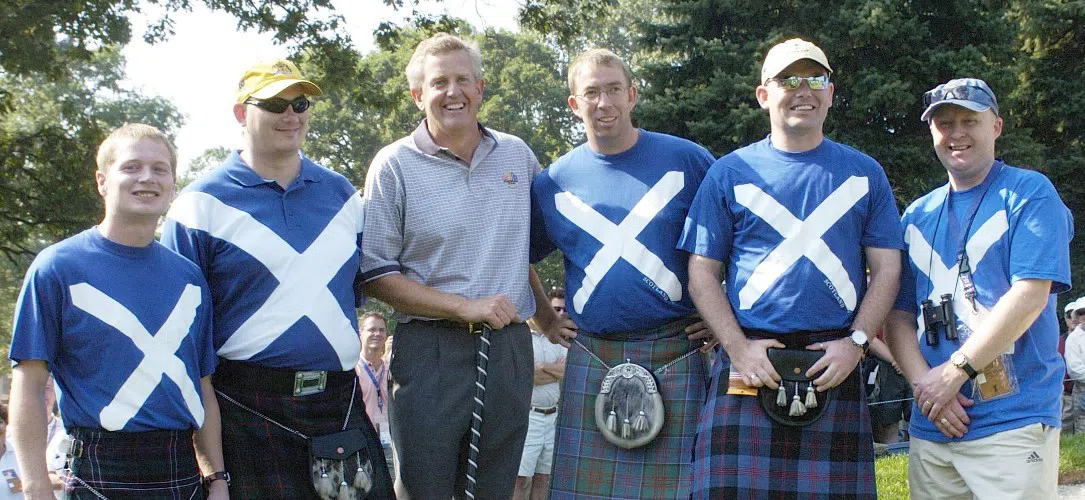
So many Scots, all with tales to tell, but when conversation turns to Scotland and the Ryder Cup there is one man who has his own very special chapter – Colin Stuart Montgomerie.
Monty, as he was known, never won a major and rarely cracked a smile on the course, yet European fans adored him.
He made his Ryder Cup debut at Kiawah Island in 1991, the edition termed the War on the Shore for all its animosity and acrimony. And Monty loved it. Coming from four down with four to play to tie his singles match with Mark Calcavecchia, while an exuberant US crowd pretty much jeered everything he did, lit the fuse.
Europe didn’t win at Kiawah Island but Montgomerie was hooked.
The great Scot would in total play eight Ryder Cups and boasted the remarkable record of never losing a singles match.
He sank the winning putt in 2004 at Oakland Hills and his one tilt at captaincy also ended perfectly with victory at Celtic Manor in 2010. They urged Monty to go again but the old warrior knew to go out at the top.
Monty’s part in the fabled story of the Ryder Cup is close to legendary but plenty of other Scots will come and go in their attempt to emulate what the great man did.
Who knows, maybe MacIntyre will one day be the Ryder Cup’s next King of Scotland.