



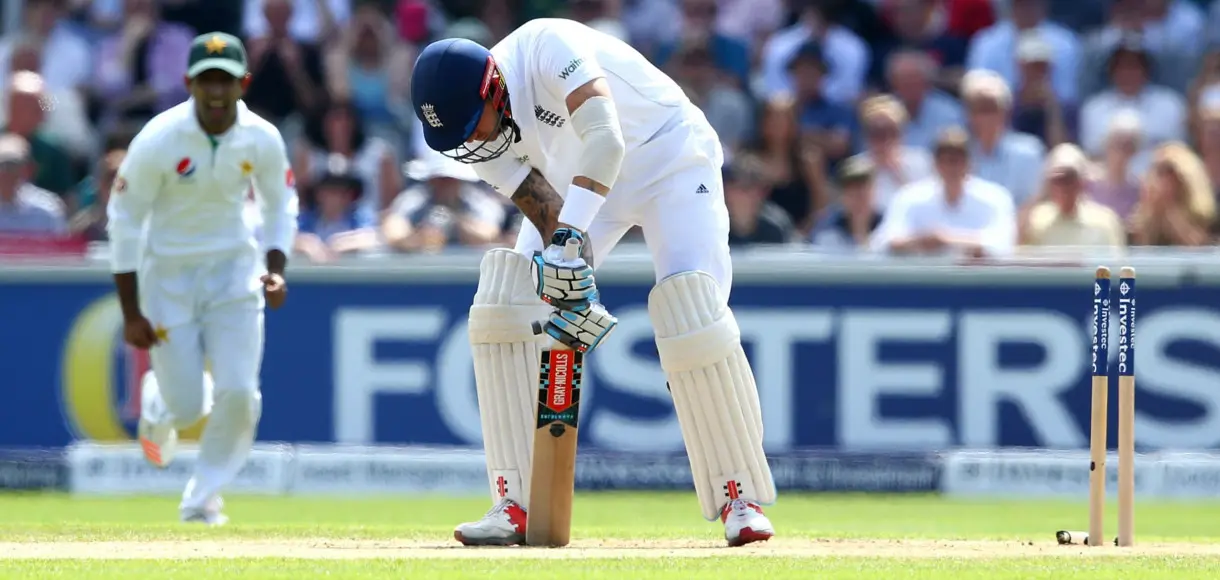
Trevor Bayliss’ encouragement to supposed one-day specialists offers hope to the England opener, who has struggled in the longer format
In hindsight, Alex Hales timed his ascent into the England reckoning to perfection.
Hales already had 32 T20 internationals to his name – including a spectacular century at the World T20 in the March of 2014 – by the time he was handed an overdue ODI debut in September of that year.
His first three months, though, were spent being drafted in and quickly dropped back out of the side.
Yet the fact that they coincided with the final chapter of Alastair Cook’s stilted regime meant that, despite his hitherto indifferent form, he remained the popular choice to replace the hapless captain at the top of the order by the time he stepped down.
Public sentiment has been in his favour ever since.
So the question mark currently hovering over his head brings a new pressure that has rarely burdened his international career in the past.
A mere 145 runs in eight innings against Pakistan in the recent Test series hardly repaid the faith shown in him by the England selectors after a disappointing debut series in South Africa last winter.
The hush around the Oval as he traipsed off in the second innings of the final Test betrayed the crowd’s uncertainty as to whether he deserved another chance.
It is that doubt in his ability that he must now overturn.
The problem for Hales is that he seems to have ignored his one-day talents when donning England whites.
Even ignoring the obvious lack of runs, a Test strike-rate of 43.8 hardly adheres to Trevor Bayliss’ long-held view that Cook must be partnered by an aggressor at the top of the order.
But that statistic belies Hales’ true ability as an opener, with the equivalent number in the first-class game pushing 60.
His rapid run-scoring ability is undeniable, but he must rediscover his confidence in order to showcase it.
And the upcoming one-day series against the same opponents is the perfect opportunity to do just that.
The 27-year-old’s ODI form is excellent.
A century in the UAE last November was backed up by at least 50 in all five of the ODIs in South Africa earlier this year.
He then scored 133* in a record-breaking stand with Jason Roy at Edgbaston against Sri Lanka in June.
And as much as ODI performances cannot exclusively inform Test match selection, the England hierarchy evidently read plenty into it.
Jonny Bairstow and – in particular – James Vince earned themselves a chance in the Test team under Bayliss having impressed in the shorter formats.
Hales himself – who admittedly did also rack up over 1,000 runs in domestic first-class cricket in 2015 – probably wouldn’t have been given the nod had he failed at ODI level.
Jason Roy and Jos Buttler – with indifferent red-ball records – are both vocally being considered by Bayliss because of the temperament and attitude they have displayed in coloured clothing, too.
Indeed, when discussing Buttler the Australian coach was quoted in July saying that “he’d be better in Test cricket if he played like he does in the white-ball game”.
Hales should heed such advice.
It is fair to assume that Bayliss and Cook already have a good idea that Hales’ future as Test match opener is in doubt.
But clearly, selecting an eighth replacement for Andrew Strauss since his retirement over four years ago is far from an ideal scenario.
So, despite his recent struggles, Bayliss’ encouragement to supposed one-day specialists should offer England’s solitary T20 centurion hope.
Ironically, it is precisely by bashing the white ball here, there and everywhere during the next two weeks that could preserve Hales’ future as much more than just a one-day dasher.