


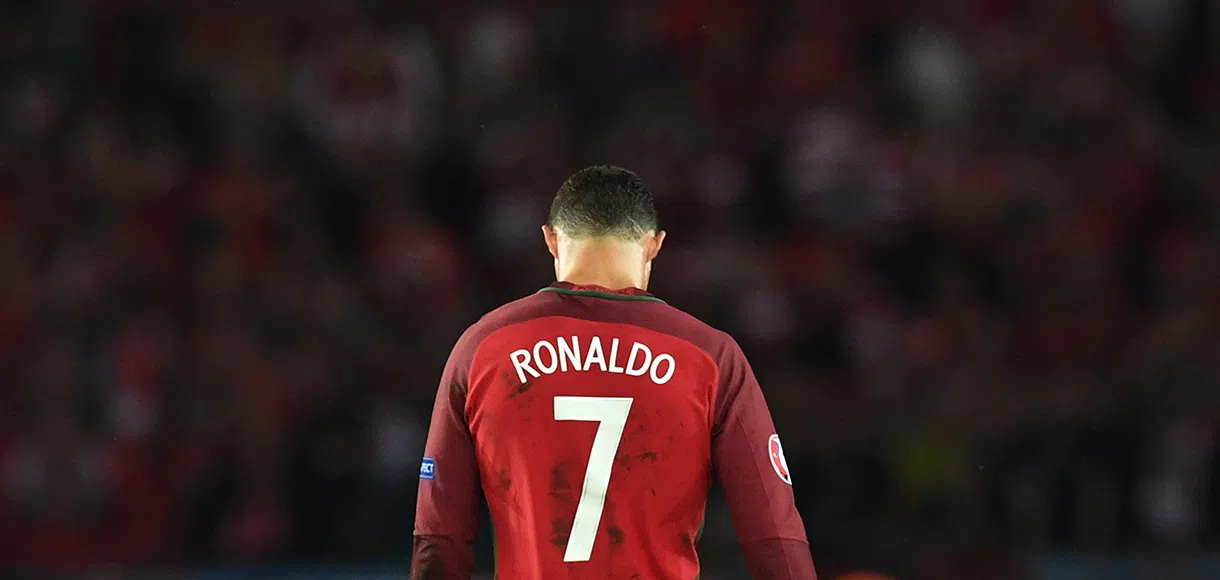
Who gets your vote? Two of our writers go against each other to debate the role of the three-time Ballon d'Or winner in Portugal's Euro 2016 campaign so far
The argument for: ‘He would rather try and fail on his own than merely contribute and succeed’
All footballers are self-serving. They have to be.
Like any elite sportsperson, if they did not constantly strive for universal recognition then they would simply never reach the pinnacle of their profession.
But there is a reason why golf, tennis, boxing and the like have never managed to capture the public imagination quite like the beautiful game.
Football’s charm has always lay in its underlying team ethos.
Cristiano Ronaldo, though, has never had any interest in sharing the glory.
This is a man who, last season, chose not to celebrate a Karim Benzema goal for Real Madrid because the referee had not awarded him a penalty in the build-up.
Whose club tried to censor the reporting of how much they paid for Gareth Bale for fear of him discovering he was no longer the world’s most expensive player.
For a man who has broken virtually every record going – in the last week alone he became his country’s most-capped player and the first in history to score at four separate Euros – the impression that such an inflated ego could be so easily burst is mystifying. Sad, in fact.
Even at the age of 31 and with his body inevitably starting to tire, he remains by some distance Portugal’s best player.
That, though, does not justify the sheer contempt – with hands on hips, puffed-out cheeks and permanently shaking head – with which he treats his team-mates.
Such behaviour would be unedifying in the school playground, let alone on the international stage.
As for the full-blown foot-stamping tantrum witnessed against Hungary on Wednesday? Well, that would look out of place even in a kindergarten.
That game also saw him score a brace – one a sensational back-heeled flick – to keep Portugal in the competition.
Yet the truth is that his side were in such dire straits because of his stubborn determination to steal the headlines, not despite it.
Any player can miss the odd sitter – such as his point-blank header against Iceland – or even the occasional penalty like his effort that hit the post in the Austria game.
As much as pretends otherwise, he is only human after all.
Only he, though, could unashamedly waste endless opportunities by blasting speculative free-kicks into the wall or high over the bar and shooting on sight rather than trust in his colleagues to help carve out a better chance.
He cannot do it on his own – that much is obvious – but he would rather try and fail than merely contribute and succeed.
His comments about the “small mentality” of Iceland – a team that beat Portugal to second place in Group F – were laughable, and betrayed his complete obliviousness to the power of teamwork and sportsmanship.
The notion that such narrow-mindedness is all part of being a winner is preposterous – as proven by the countless former greats who will be remembered with far more fondness than he ever will.
Unfortunately for him, the more he ages ungracefully, the more tarnished that legacy becomes.
– Tom Clee
The argument against: ‘The ultimate individual athlete whose genius just happens to be in a team sport’

The thing I admire most about Ronaldo? His courage.
Even though he has missed vital penalties over the course of his career, he is always ready – and eager – to take the next one.
The same goes for free-kicks, although he would probably be better off delegating that responsibility to someone else given how often he has ballooned them into the stands at the Euros.
And while his performances at the tournament have been poor, Portugal would be out of it had Ronaldo not assisted Nani and scored two – including that deft back-heeled finish – against Hungary.
When his passive team-mates went missing, the country’s all-time record appearance-maker and scorer did what he always has: delivered.
For those who dislike him, Ronaldo’s petulance towards his colleagues is emblematic of someone who believes he is above the 10 other players he lines up with.
This is true.
Ronaldo is the ultimate individual athlete – think Tiger Woods, Roger Federer and Michael Schumacher in their prime – whose proclivity for genius just happens to be in a team sport.
But those gesticulations – which have always been prevalent – are definitely more pronounced this summer.
Ronaldo is not angry at his team-mates, though. They have always been rubbish compared to him. He is angry at himself and his ailing body.
The 31-year-old is clearly not fit. He hasn’t been for a long time.
Spanish journalist Guillem Balague, who last year published an acclaimed biography on the player, has said several times over the last 12 months that the three-time Ballon d’Or winner is past his peak physically.
Despite that, Ronaldo still plundered more than 50 goals during the 2015/16 season – the sixth successive season he has done so at Real Madrid – and won his third European Cup.
This, clearly, cannot go on forever. And even the person who has a museum dedicated to himself is not self-obsessed enough to believe that he can evade time.
Yet still he attempts to.
Because having trained himself to be a complete footballer, extracting every available bit of himself is all he knows.
In the 2015 documentary Ronaldo – where his PR team would have studied each frame before granting approval – the film’s subject came across as lonely, obsessive and unfulfilled.
Those are feelings every person, world-class athlete or otherwise, can relate to.
The realisation that our bodies can no longer do the things we want them to – and the difficulty in accepting that – is something we will all experience one day.
Ronaldo is just enduring it 30 years earlier than most.
The in-front-of-our-eyes decline of one of the greatest footballers ever, therefore, should be met with empathy rather than scorn.
Clee is right. The Euros have proved that Ronaldo is human, after all.
But after a decade of being otherwise, that is endearing.