Endurance and perseverance are common themes for the Nigerian, whose reputation has crumbled since an excellent 2015...
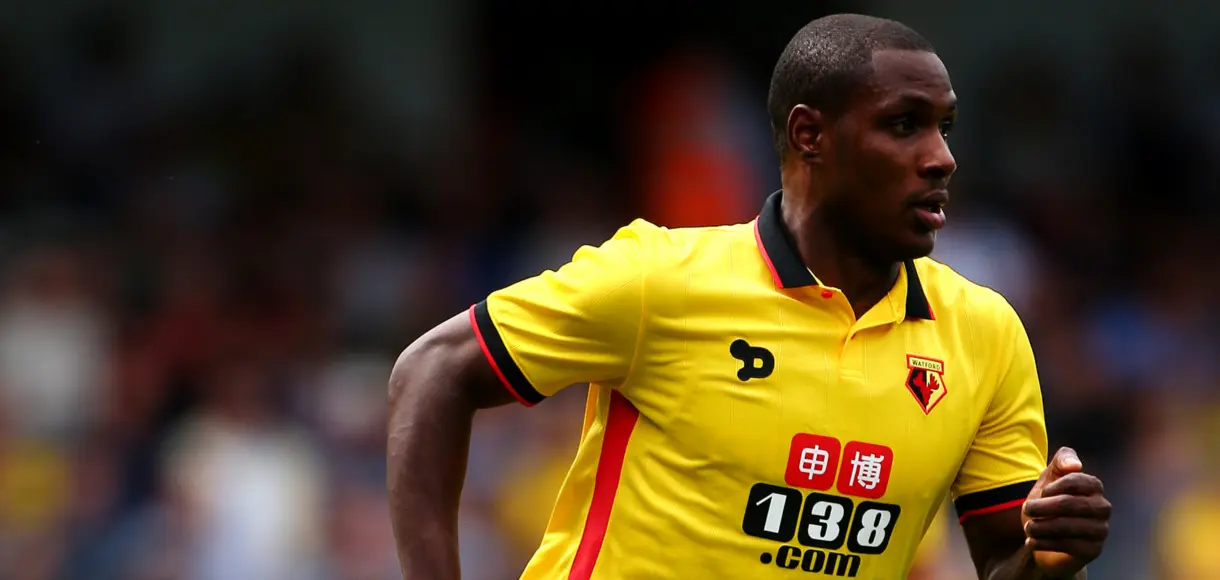
The perception of Odion Ighalo’s Premier League career is clear evidence of the lack of perspective in football.
On 28 December last year, Ighalo’s goal for Watford against Tottenham was not only his seventh in six matches.
It also ensured that he was – by three clear goals – English football’s highest scorer in 2015.
Vital strikes they were, too.
A staggering run of 11 in seven games was pivotal to the Hornets’ 2014/15 promotion-winning campaign, before his potency consolidated their place in the top tier.
His partnership with Troy Deeney caused a problem for virtually every Premier League centre-half.
And Manchester United were evidently impressed – Watford turned down a £35m bid for Ighalo from Ed Woodward in January.
Yet just ten months on, the Nigerian has not only been brushed aside as a has-been by neutrals, but is the subject of frustration and disappointment at Vicarage Road.
Plenty consider him too limited – a striker who flourished in one bright spell and was then quickly worked out.
That, though, is subscribing to a theory that 30 goals in a calendar year is an anomaly.
Some leap.
Clearly, the goals are not flowing.
He has netted just one deflected effort so far this season and missed an open goal against Manchester United that drew plenty of social media mirth.
But adversity is customary for Ighalo.
While playing for Olodi Warriors – his first club in Nigeria – he regularly trained as gangs and police fired bullets at each other in the same field.
He was then forced to deal with temperatures up to 70 degrees colder when scouted by Norway’s Lyn Oslo at 17.
A poor run in front of goal is insignificant, by comparison.
And Ighalo has had it tougher in England, too.
New to the country in 2014, he managed just three goals in his first 16 Watford appearances.
Overshadowed by Deeney, Matej Vydra and Fernando Forestieri, the 27-year-old might have wondered what he was even doing here.
He finished that campaign with 20 goals, though, proving several wrong in the process.
Even in the summer of 2015 – post-promotion – he forced then-boss Quique Sanchez Flores to improvise with a 4-4-2 formation after scoring off the bench at Everton on the opening weekend.
And there is mitigation for this current stumble.
Ighalo’s father died back in Nigeria in April – a tragic reminder that he has left much of his life on the other side of the world.
On the pitch, too, he was identified as one of the more dangerous strikers in the division and was accordingly targeted.
Never has he been so exhaustively studied as in 2016 – by the best defenders in the country, too.
But Ighalo’s persistence is a common theme.
His resolve – from poverty-stricken Lagos to the Premier League – has passed the endurance test.
Don’t rule him out just yet.