


From Juande Ramos to Arthur Rowe, we run through Tottenham's most successful managers and select the greatest ever.
Tottenham may not have celebrated a trophy success since 2008, but they are still a club with an illustrious past and have had some great managers at the helm.
The north London club won the old First Division twice, the UEFA Cup twice, the UEFA Cup Winners Cup once and have lifted the FA Cup eight times and the League Cup on four occasions, and they’ve been led by some big-name managers both from England and further afield.
Read on for our list of the top 10 bosses to have been in the Spurs dugout, and make sure to explore our ranking of the greatest Premier League managers ever, and our football betting page for the latest Tottenham odds and markets.
Best Spurs managers ever
10. Juande Ramos
Juande Ramos was in charge the last time Tottenham celebrated a trophy success, which is the reason why he has been included in this list even though he had only a brief spell at the White Hart Lane helm.
He took over from Martin Jol in October 2007 and the League Cup run that season was the big highlight as Spurs beat Arsenal 5-1 in the semi-final second leg before seeing off Chelsea in extra-time in the Wembley final.
Ramos was sacked after Spurs took just two points from their eight games the following season, but at least he was responsible for signing Luka Modric, undoubtedly one of the greatest midfielders to have played for the club.
9. Martin Jol
Martin Jol was pushed into the Spurs club following the shock departure of Jacques Santini in November 2004 and adhered himself to the fans with his brand of attacking football.
It was almost enough to earn the club a spot in the Champions League in 2006, but they were denied on the final day when illness in the camp struck before their final game of the season at West Ham.
However, Jol did take Spurs into the Uefa Cup twice and the fact the news of his 2007 sacking came during a game against Getafe made him even more popular with the supporters.
8. George Graham
George Graham’s arrival at Tottenham in October 1998 was highly controversial as he had such a deep association with arch rivals Arsenal, where he enjoyed great success as both a player and a manager.
Like Ramos, the fact he claimed a trophy during his spell at White Hart Lane earned him a place in the list as he was in charge when they beat Leicester City in the 1999 League Cup final.
However, he was never taken to the supporters’ hearts and few tears were shed when he was sacked in 2001 and he has never returned to management.
7. Harry Redknapp
Harry Redknapp came in on his white horse to take over after Juande Ramos was sacked in October 2008 and a 4-4 draw at Arsenal in his second game in charge was a sign of things to come.
He took Spurs to the League Cup final the following March, which they lost on penalties to Manchester United and, in his first full season in charge, the team secured fourth spot in the Premier League to qualify for the Champions League.
They reached the quarter-finals, where they were beaten 5-0 on aggregate by Real Madrid and they were unfortunate not to be at Europe’s top table for the 2012-13 season despite finishing fourth, as their place was taken by Champions League winners Chelsea.
6. David Pleat
David Pleat’s first spell in charge at the club, which started in 1985, was brief but his team produced some of the best football seen at White Hart Lane.
He was in charge during the 1986-87 season when he pioneered the 4-5-1 formation, with striker Clive Allen having a dream season, scoring 49 goals while supported by talents such as Osvaldo Ardiles, Glenn Hoddle and Chris Waddle.
But it was a season of what might have been as Spurs finished third in the league behind Everton and Liverpool, lost a League Cup semi-final replay to an injury-time goal against Arsenal and fell 3-2 in one of the classic FA Cup finals against Coventry City.
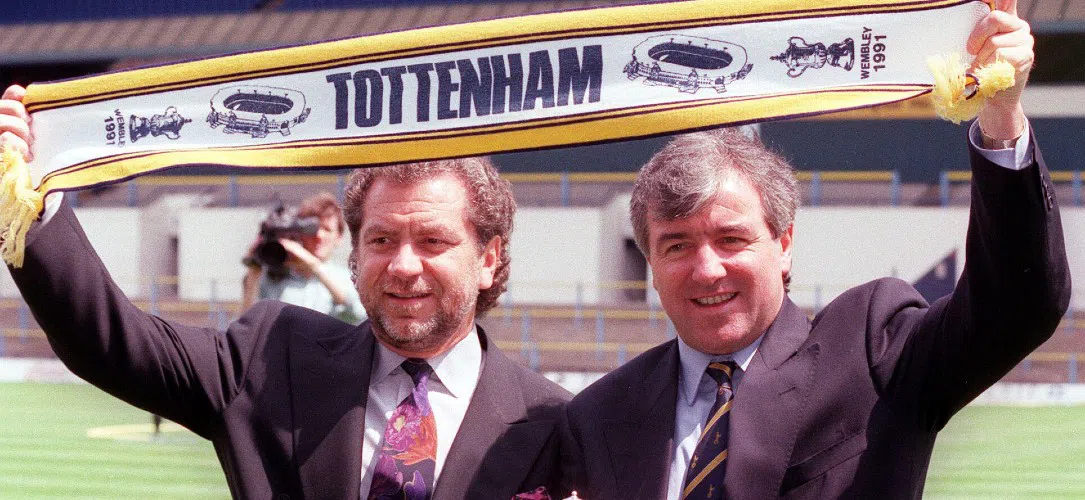
5. Terry Venables
Terry Venables replaced Pleat in October 1987 and managed to eclipse his predecessor in our list after guiding Spurs to a FA Cup success over Nottingham Forest in 1991.
That was the highlight of his spell in charge which was littered with mid-table finishes, but he was the man who signed the brilliant Paul Gascoigne and also brought Gary Lineker back to English football after coaching the England striker at Barcelona.
4. Mauricio Pochettino
Mauricio Pochettino was unable to claim a trophy during his five-year spell in charge of the club, but he will be more highly regarded than many who did win things.
The Argentinian produced a team that played dazzling football as young talents such as Harry Kane and Dele Alli combined with shrewd signings such as Heung-min Son, Moussa Dembele and Toby Alderweireld to produce some of the best football the club has ever seen.
He took the club to the 2019 Champions League final where they were beaten by Liverpool after a memorable semi-final comeback against Ajax and, while he now manages the USA national team, there is still a sense he has unfinished business in N17.
3. Keith Burkinshaw
After a brief spell under Terry Neill, Tottenham needed a lift in 1976, but they suffered the disappointment of relegation to the Second Division under Keith Burkinshaw.
The future looked gloomy but the Spurs board kept faith in the Yorkshireman and he got them back up at the first attempt before shocking the football world by signing Argentina World Cup winners Osvaldo Ardiles and Ricardo Villa.
Aided by the development of Glenn Hoddle into one of the best young players in the country, things took off in 1981 when they beat Manchester City in the 1981 FA Cup final replay, with Villa scoring a winning goal that is probably the greatest in the club’s history.
They repeated the success against QPR the following year when they lost out in the League Cup final to Liverpool when they led with just minutes to go and were beaten by Barcelona in the Cup Winners’ Cup semi-finals.
Burkinshaw did bring European success to the club two years later, however, when they beat Anderlecht on penalties in the Uefa Cup final in what was probably the greatest game played at the old White Hart Lane.
2. Arthur Rowe
Arthur Rowe was the first manager to win the First Division at Tottenham which he did in the 1950-51 season with a team that included future England manager Alf Ramsey.
Rowe, who was born within a goal-kick of White Hart Lane and played for the club as a centre-half before the Second World War, took over the previous season with Spurs in the Second Division.
It was a great achievement but he is remembered more for being a pioneer of push-and-run football, which involved keeping possession and collecting what became colloquially known as one-twos.
One of his players Vic Buckingham went on to manage both Ajax and Barcelona, where Rowe’s ideas are credited with playing a key role in the development of Total Football.
1. Bill Nicholson
Bill Nicholson was another player to feature in Rowe’s team, but the greatest manager in Tottenham’s history would go on to eclipse his former boss’ achievements.
Nicholson, a true one-club man, took over the reins in 1958 after moving up the coaching ranks and was in charge of the legendary 1960-61 team who became just the third side in English football history to complete the First Division-FA Cup double.
The team was strengthened for the following season by the signing of Jimmy Greaves, one of England’s greatest goalscorers and they retained the cup that year with a win over Burnley, while they became the first English team to win a European trophy when they beat Atletico Madrid in the 1963 Cup Winners’ Cup final.
Another FA Cup success came against Chelsea in 1967, while the new decade also brought trophy joy with League Cup wins in 1971 and 1973 which were separated by a UEFA Cup success in 1972.
He stood down in 1974 and Bill Nicholson Way led to the old stadium before the move to a new home.